
Data Analyst Internships in the UK: How to Find One, and What to Do Instead

Internships are the most competitive route into data analysis and the least available. Here is how to compete for one, and how to build the same evidence without one.
Internships sit in an awkward place in data analysis. They are the most requested route into the field and one of the least available, particularly for career changers who are not currently students.
This guide covers both halves: how to compete for the ones that exist, and what to do instead, because the alternatives are genuinely competitive with a formal internship if you build them properly.
What a UK data analyst internship actually looks like
Most fall into one of three shapes.
Structured summer internships at large employers, typically eight to twelve weeks, aimed at penultimate-year undergraduates, paid, with a defined project and a mentor. These are the most competitive and the most useful, because they frequently convert to graduate offers.
Placement years, usually twelve months as part of a sandwich degree. The strongest version of the route, because a year is long enough to own real work.
Informal internships at smaller companies, which in practice are fixed-term junior roles labelled as internships. Less structured, far less competitive, and often better learning because you touch everything.
Career changers should focus on the third category, and search for terms like "trainee analyst", "analyst placement" and "fixed-term data analyst" alongside "internship".
Pay, and your rights
Structured internships at established UK employers generally pay, commonly between the National Minimum Wage and around £24,000 pro rata. For reference, the advertised median for a graduate business analyst is £26,000, so internship pay sitting somewhat below that is normal.
One thing worth knowing: in the UK, if you are doing work that benefits the employer and have set hours and responsibilities, you are usually classed as a worker and entitled to at least the National Minimum Wage. Unpaid internships of that kind are, in most cases, unlawful. Genuine work shadowing and voluntary work for a charity are treated differently. If an advert offers an unpaid full-time analyst role at a commercial company, that is a reason to look elsewhere rather than a bargain.
When and where to apply
Timing is the thing most applicants get wrong. Large employers recruit summer interns from roughly September to January of the preceding academic year, and many close early when they have enough applicants. Applying in April for that summer is usually too late for the structured schemes and about right for the informal ones.
Where to look:
- Bright Network, Milkround, RateMyPlacement and Prospects for structured schemes
- LinkedIn and Indeed, filtered to internship and fixed-term, for the informal ones
- NHS Jobs and Civil Service Jobs, which run analyst placement and internship schemes that never appear on commercial boards
- Your university careers service if you have one, including as an alumnus, which many graduates forget is available for years after leaving
- Directly to small local employers, which is unfashionable and works, because they are rarely advertising and often have data nobody has looked at
The four alternatives, and why they work
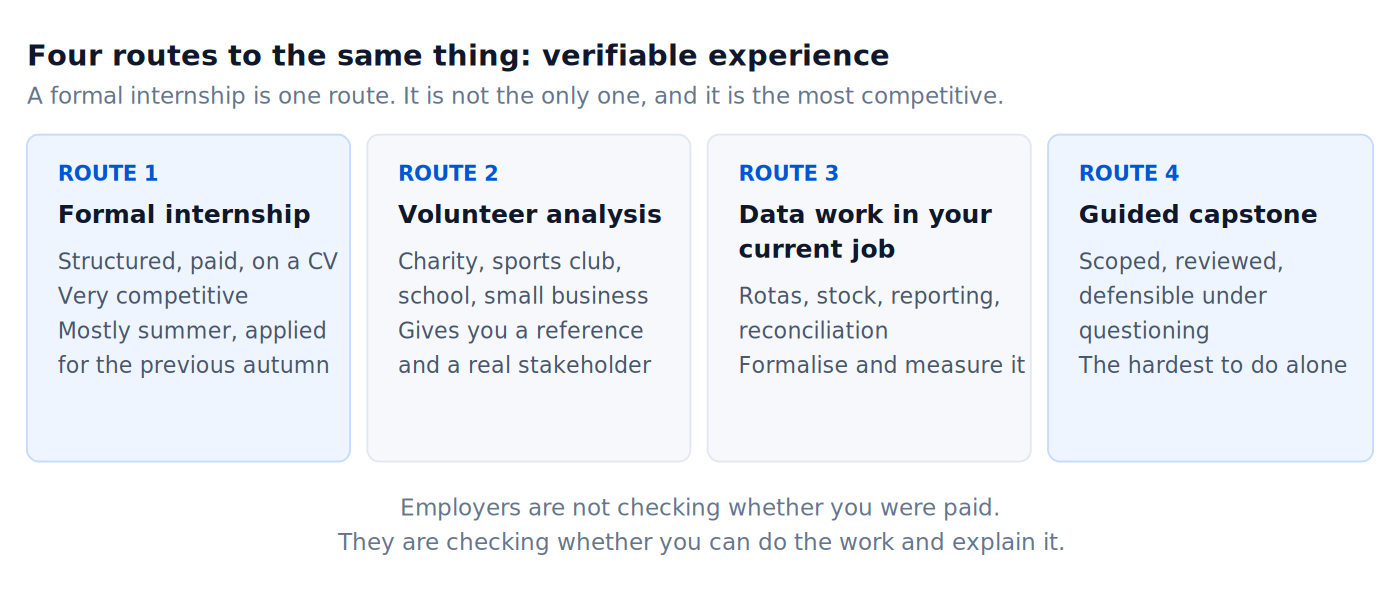
Employers are not checking whether you were paid. They are checking whether you can do the work and explain it. That is the whole test, and there are four ways to pass it.
Volunteer analysis for a small organisation. A charity, a sports club, a school, a community group. Nearly all of them have data in spreadsheets that nobody has properly examined. This gives you three things an internship gives you: a real stakeholder with real questions, constraints you did not choose, and a reference.
Data work inside your current job. If you build the rota, own a tracker, reconcile figures or produce the monthly numbers, that is analyst work. Formalise it, improve it, and attach a measurement to it. Many career changers already have relevant experience and describe it as administration.
A guided capstone project. Scoped, reviewed and defensible under questioning. This is the hardest to produce alone, because scoping a realistic business problem is a skill in itself, which is why structured programmes are useful here.
Freelance or contract micro-projects. Small businesses will pay modest amounts for a dashboard or a one-off analysis. Even one paid engagement changes your CV from unemployed career changer to analyst with clients.
How to present non-internship experience
The framing matters as much as the work.
Weak: "I did a personal project analysing charity donation data."
Strong: "I worked with a local food bank to analyse three years of donation and distribution data. I found that 40% of stock waste came from two product categories with mismatched donation and demand cycles, and recommended a change to their collection scheduling."
The second version has a stakeholder, a constraint, a finding and a recommendation. That is what an internship would have given you, and an employer cannot tell the difference from the description.
If you do get one, use it properly
Interns who convert to offers do a small number of specific things:
- Ask what decision their work will inform, before starting it
- Document what they built well enough that someone else can maintain it
- Find one small thing that is broken and fix it without being asked
- Leave with a written summary of what they delivered, with numbers attached
- Ask for a LinkedIn recommendation in the final week, while the work is fresh
Frequently asked questions
Do data analyst internships pay in the UK? Structured internships at established employers generally pay, commonly between the National Minimum Wage and around £24,000 pro rata. Unpaid internships for work that benefits the employer are, in most cases, unlawful in the UK because the intern qualifies as a worker entitled to at least the minimum wage.
When should I apply for a UK data analyst internship? Large employers recruit summer interns from roughly September to January of the preceding academic year, with many closing when full. Smaller employers recruit much closer to the start date, often only weeks ahead.
Can you get a data analyst internship without being a student? Some schemes are restricted to students or recent graduates, but many smaller employers use "internship" as a loose label for a fixed-term junior role and do not restrict eligibility. Career changers should search fixed-term and trainee analyst roles as well.
Is an internship better than a portfolio? They do the same job, which is providing evidence. An internship is more credible by default; a strong portfolio with a real stakeholder and a recommendation closes most of the gap and is available to everyone.
Sources: ITJobsWatch, Graduate Business Analyst and Data Analyst job trends, 2026; GOV.UK guidance on employment rights for interns; Department for Education AI & Future of Work Unit with LinkedIn, April 2026. Employment rights guidance is general information, not legal advice.
Read next
- Data analyst jobs with no experience
- How to build a data analyst portfolio
- Graduate data analyst jobs and schemes
Build the experience an internship would have given you
Uptrail's Data Career Programme ends in mentor-reviewed portfolio projects built on real UK sector data, which is the evidence employers are actually looking for when they ask about experience.
Explore the Data Career ProgrammeBook a free consultation