
Data Analyst Jobs With No Experience: What Actually Works in 2026

Entry-level analyst hiring fell 15% last year. Here is what still works: the titles to target, the evidence employers want, and the mistakes that stall capable people.
Every guide on this topic opens by telling you the market is full of opportunity. Let us start somewhere more useful, with what the numbers actually say, because the strategy that follows only makes sense once you accept the situation.
The state of entry-level hiring, honestly
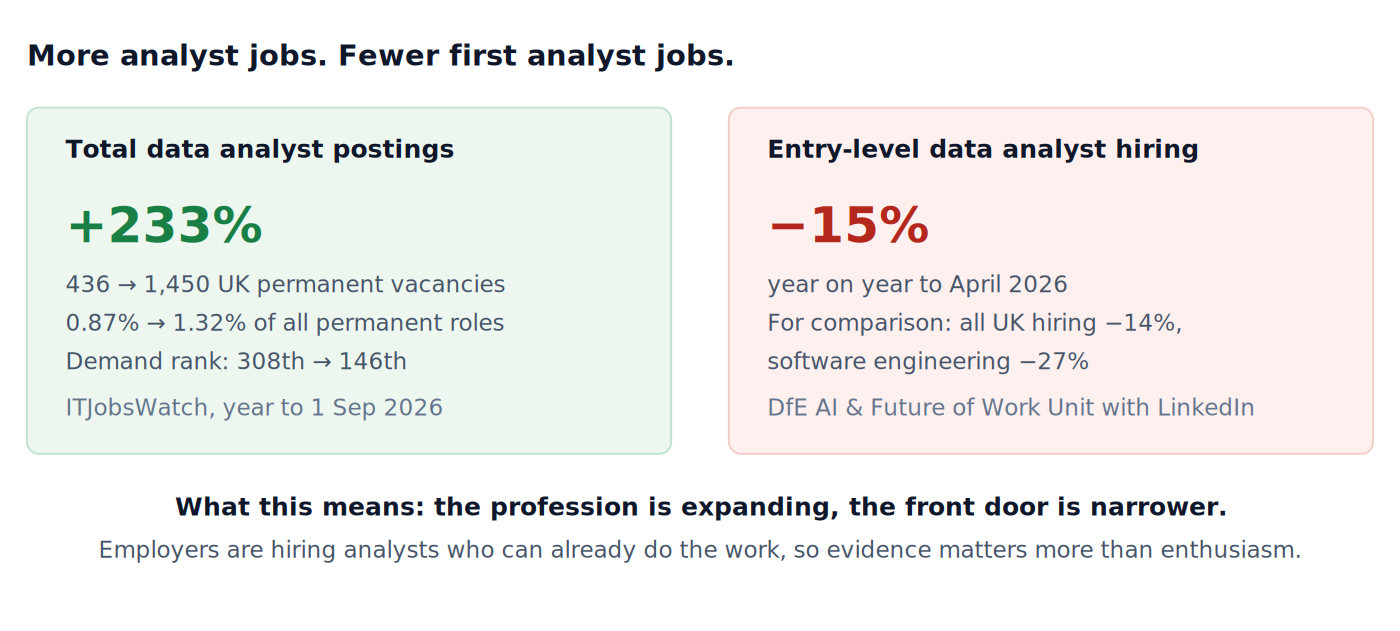
Entry-level data analyst hiring in the UK fell 15% in the year to April 2026, according to analysis by the Department for Education's AI & Future of Work Unit with LinkedIn. Of 38 UK entry-level occupations tracked, 30 were declining.
Wider context matters here. Overall UK hiring fell 14% over the same period, so data analysis is not being singled out. Entry-level software engineering fell 27% and accountancy 29%. And UK job postings open to new graduates were around 7% lower year on year as of August 2026, per Indeed data reported by the Financial Times, their lowest for the time of year since 2020.
Meanwhile, total data analyst postings rose sharply, from 436 to 1,450 permanent UK vacancies year on year.
The pattern is consistent: the profession is growing, the front door is narrower. Employers are hiring analysts who can start producing quickly, and are less willing to fund a long ramp-up.
You cannot change that market. You can change how much evidence you walk in with.
Build the experience before anyone hires you
"No experience" means no employment history. It does not have to mean no work.
Analyse something real and publish it. UK government open data, NHS Digital, TfL, the ONS and Kaggle all give you genuine, messy datasets. One thorough analysis of local authority spending patterns beats five tutorial dashboards.
Do the work for a small organisation. A local charity, a sports club, a family business, a school. They almost all have data in spreadsheets that nobody has looked at properly. This produces a reference, a real stakeholder and a story about handling constraints, which is worth more than the analysis itself.
Take data work in the job you already have. If you build the rota, own a spreadsheet, or pull the monthly numbers, that is analyst work. Formalise it. Improve it. Put a figure on the time it saved. Many career changers already have relevant experience and describe it as admin on their CV.
Complete a structured capstone. A guided end-to-end project gives you the one thing self-directed learners struggle to produce: something finished, reviewed and defensible under questioning.
Target the titles nobody else is searching
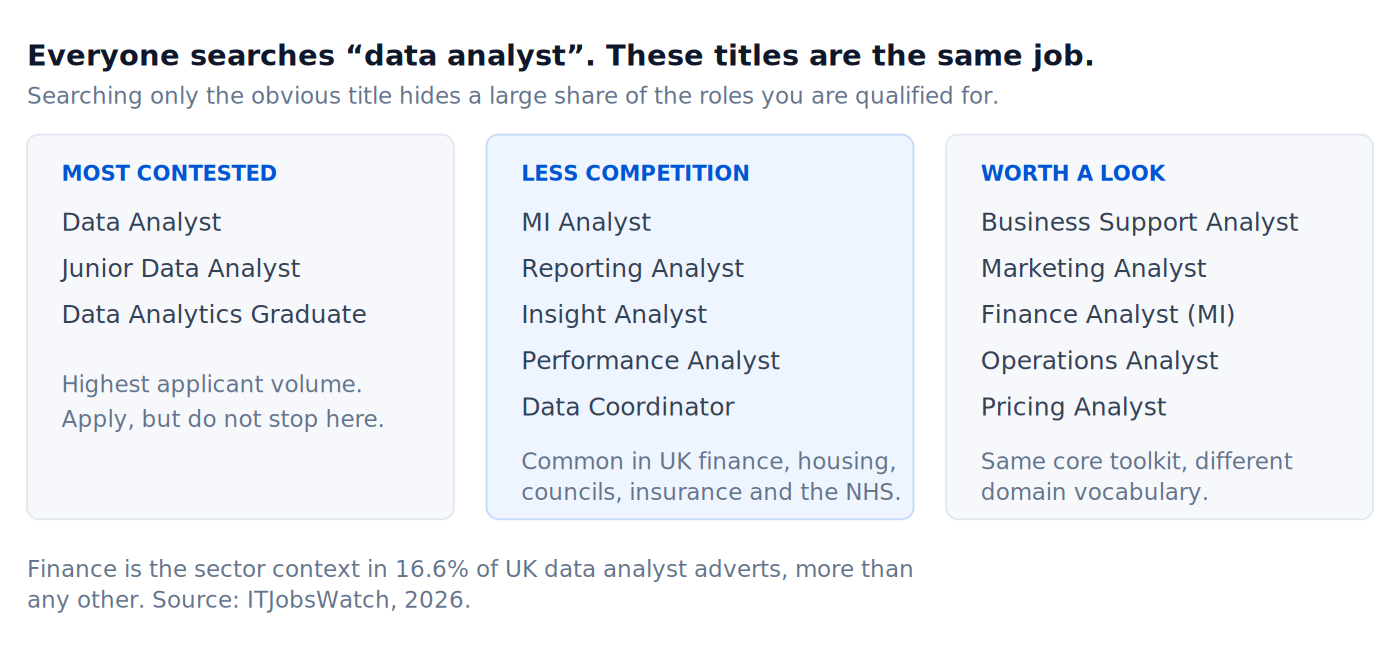
Everyone applies to "Junior Data Analyst". Fewer people search for these, and UK employers use them constantly:
- MI Analyst (management information, extremely common in UK finance, insurance and housing)
- Reporting Analyst
- Insight Analyst
- Data Coordinator
- Business Support Analyst
- Performance Analyst (very common in the NHS, councils and education)
Sector matters too. The public sector, housing associations, the NHS and insurance hire more genuinely junior analysts than tech companies do, and their adverts are less contested. They also tend to pay slightly below the £50,000 national advertised median, which is precisely why competition is lower.
Widen your map
The advertised median outside London is £45,000, up 5.9% year on year, while London's median fell 9.8% to £57,500. Demand ranking improved by 215 places outside London versus a slight decline within it. Yorkshire, the North West, the Midlands and the South West have all seen posting volumes climb.
If you are geographically flexible, or targeting the 212 postings that were advertised as home-based, your options are considerably wider than a London-only search suggests.
The three mistakes that stall capable people
Applying before there is anything to show. The most common one by far. Six weeks of learning plus fifty applications produces fifty rejections and a conclusion that the market is impossible.
Applying at volume. With three-figure applicant counts on many roles, an untailored application is not a lottery ticket, it is noise. Fifteen carefully targeted applications outperform two hundred generic ones, consistently.
Leading with tools instead of outcomes. "Proficient in SQL, Power BI and Excel" describes several thousand other applicants. "Built a Power BI report identifying £40k of duplicated supplier spend across three cost centres" describes one.
What to do in your first fortnight
- Pick one dataset in a sector you would actually want to work in.
- Write down the single business question you are answering, before you open any tool.
- Do the analysis, and document what you cleaned and why.
- Write four sentences: question, method, finding, recommendation.
- Publish it somewhere linkable and put that link on your CV and LinkedIn.
That sequence, repeated three times, puts you ahead of most people applying for the same roles.
Frequently asked questions
Is it still worth trying to become a data analyst if entry-level hiring is down? Yes, but with realistic timelines. The profession is expanding and the fall in entry-level hiring tracks the wider market rather than being specific to data. Expect the application phase to take two to four months.
Do employers actually look at portfolios? Not always at the screening stage, where CV keywords often decide. They matter enormously at interview, where being able to talk through your own decisions is what separates candidates.
Should I take an internship or a lower-paid role first? Frequently yes. A reporting role at £26,000 that gives you twelve months of production data work puts you in a much stronger position than another six months of applying for the perfect first job.
Uptrail's AI Data Analyst Career Programme exists for exactly this problem: it is built around producing employer-facing evidence rather than a certificate, with a guided capstone and mentor feedback. If you want to talk through whether it fits your situation, book a free consultation.
Sources: Department for Education AI & Future of Work Unit with LinkedIn, A snapshot of entry-level hiring in the UK, April 2026; ITJobsWatch, Data Analyst job trends, 6 months to 1 September 2026; Indeed data reported by the Financial Times, August 2026.
Read next
Evidence beats enthusiasm
Uptrail's Data Career Programme ends in mentor-reviewed portfolio projects built on real UK sector data, plus dedicated career coaching.
Explore the Data Career ProgrammeBook a free consultation