
Digital Marketing Jobs in the UK: Roles, Pay and How to Get In

Digital marketing has the widest pay range of any entry-level career in this guide, and the gap is explained almost entirely by one thing: whether you can measure what you did.
Digital marketing is unusually easy to enter and unusually hard to progress in, and the reason is the same in both cases: the barrier is not qualifications, it is proof of results.
The main roles, and what they pay
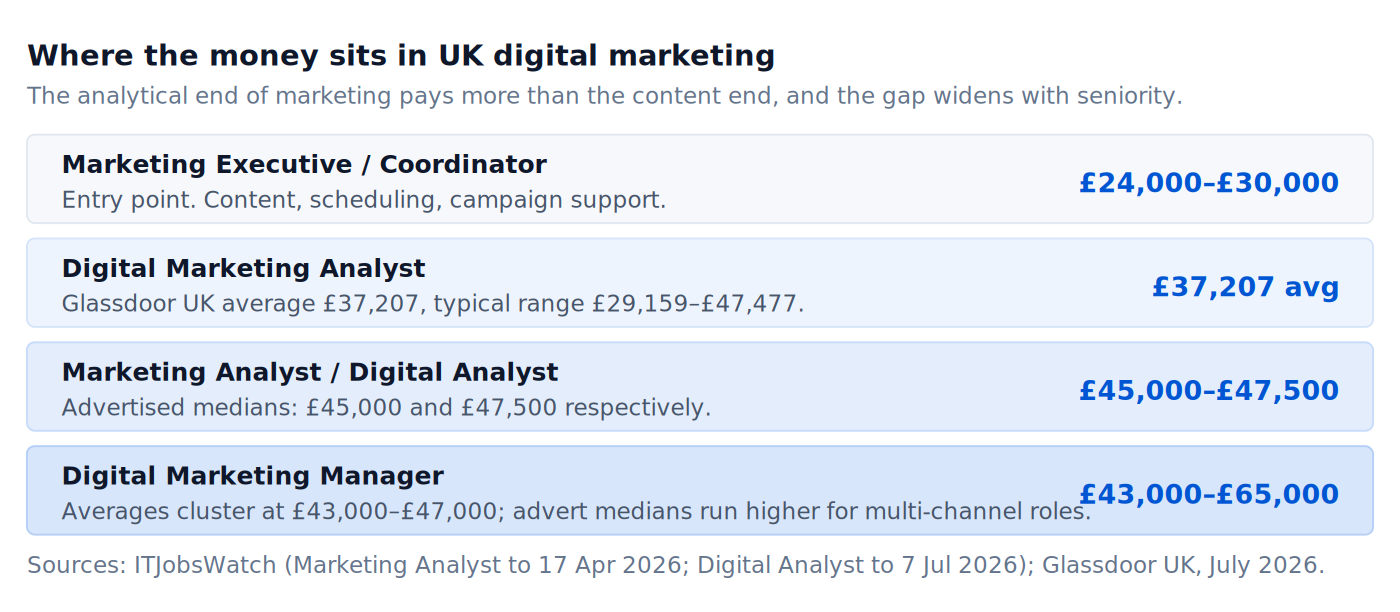
Marketing Executive / Digital Marketing Executive is the standard entry point, typically £24,000 to £30,000. Content production, scheduling, campaign support, email, reporting. Broad and shallow by design, which is useful early because it shows you which parts you like.
Digital Marketing Analyst averages £37,207 in the UK on Glassdoor data, with a typical range of £29,159 to £47,477. Focused on measurement: campaign performance, attribution, conversion analysis, reporting.
Marketing Analyst carries a £45,000 advertised median, and Digital Analyst £47,500. The more the role tilts toward data and away from content, the higher the pay.
Digital Marketing Manager averages around £43,000 to £47,000, with advertised medians running considerably higher for senior multi-channel roles, and London and paid-media-heavy positions above that.
Specialists in SEO, PPC and paid social sit above generalists at the same level, because their contribution is directly measurable against spend.
The pattern worth noticing
Every step up that pay ladder involves being closer to the numbers.
This is the single most useful observation about digital marketing careers. Content and social skills are widely held and hard to attribute to revenue. Analytics, paid media and conversion skills are less widely held and directly attributable. Employers pay for attribution.
If you are entering the field, the practical implication is to get genuinely good at Google Analytics 4, campaign measurement and paid platform reporting early, rather than treating analytics as the boring part of the job. Our guide to the digital marketing analyst role covers that path specifically.
What employers screen for at entry level
Evidence you have run something. Not studied it. Run it. A campaign with a budget, however small, and a result you can state.
Platform fluency. Google Ads, Meta Ads Manager, Google Analytics 4, a CMS, an email platform. Named tools function as keywords in screening.
Analytics literacy. Being able to say what a campaign achieved, against what, and how you know.
Writing. Still fundamental, and increasingly a differentiator now that a large share of published marketing copy is AI-drafted and reads like it.
AI fluency with judgement. Assume AI tools are used across every marketing team. What gets valued is knowing what to check, what to rewrite and where the tools produce confident, wrong output.
The portfolio that gets people hired
Digital marketing is the most portfolio-friendly of the three career paths in this guide, because you can do real work with almost no capital.
Run a real campaign with real money. £50 on Meta or Google Ads for a small local business, a friend's side project, or your own. The budget is irrelevant. What matters is that you set an objective, spent money, measured the result and can explain what you would change.
Grow something measurable. A niche site, a newsletter, a social account with a defined audience. Traffic and subscriber numbers are evidence in a way that coursework is not.
Do SEO on something real. Take a small site, audit it, fix it, and track ranking and traffic changes over three months. Documented before-and-after data is exactly what a hiring manager wants.
Build one Google Analytics 4 report that answers a specific business question, and be able to explain the data behind it.
Four small documented projects with numbers attached will beat a marketing degree with no practical work in most UK entry-level marketing processes.
Where the jobs are
Agencies hire the most junior marketers by a distance. Intense, broad exposure across clients, and typically lower starting pay. As a first job it is the fastest way to learn, and one to two years there opens most doors.
In-house teams at mid-sized companies offer deeper ownership of fewer channels and slightly better pay.
E-commerce businesses are the most measurement-driven employers in the field, and the best environment for developing the analytical skills that raise your ceiling.
Freelance becomes viable early in this career, particularly for SEO and paid social, which is unusual among professional fields.
Frequently asked questions
What does a digital marketing job pay in the UK? Entry-level marketing executive roles typically pay £24,000 to £30,000. Digital marketing analysts average £37,207 on Glassdoor data, marketing analysts carry a £45,000 advertised median, and digital marketing managers cluster around £43,000 to £47,000 on average.
Do you need a degree for a digital marketing job? Rarely. Digital marketing is one of the most portfolio-driven careers in the UK: employers assess campaigns you have run and results you can evidence far more heavily than qualifications.
Which digital marketing skills pay the most? The analytical and paid-media skills. Roles combining campaign delivery with measurement, attribution and analytics consistently pay above content and social-focused roles at the same level.
Is digital marketing being automated by AI? Content production is being compressed significantly. Strategy, measurement, brand judgement and knowing when AI output is wrong are not. As with data analysis, the work is shifting from producing to deciding and verifying.
Sources: ITJobsWatch job trend pages for Marketing Analyst (6 months to 17 April 2026) and Digital Analyst (6 months to 7 July 2026); Glassdoor UK, Digital Marketing Analyst, July 2026; published UK digital marketing salary guidance, 2026.
Read next
- The digital marketing analyst role
- Data analyst skills in 2026
- Data analyst jobs in the UK
- How to get into digital marketing with no experience
- Digital marketing skills in 2026
Fast-track your digital marketing career
Uptrail's 12-week Digital Marketing Bootcamp covers SEO and SEM, social media, content strategy, Google Analytics 4 and paid ads across Meta and Google, with live mentoring and portfolio campaigns.
See the Digital Marketing BootcampBook a free consultation