
Data Analyst Jobs in the UK: Where They Are and How to Find Them

More than 1,400 permanent data analyst vacancies were advertised in the UK over the last six months. Here is who is hiring, where, and what they are screening for.
If you have been searching "data analyst jobs" and finding the same handful of listings, the problem is probably your search terms rather than the market. There are more data analyst roles advertised in the UK right now than at any point in the last three years. They are just not all called that.
The state of the market, in two numbers
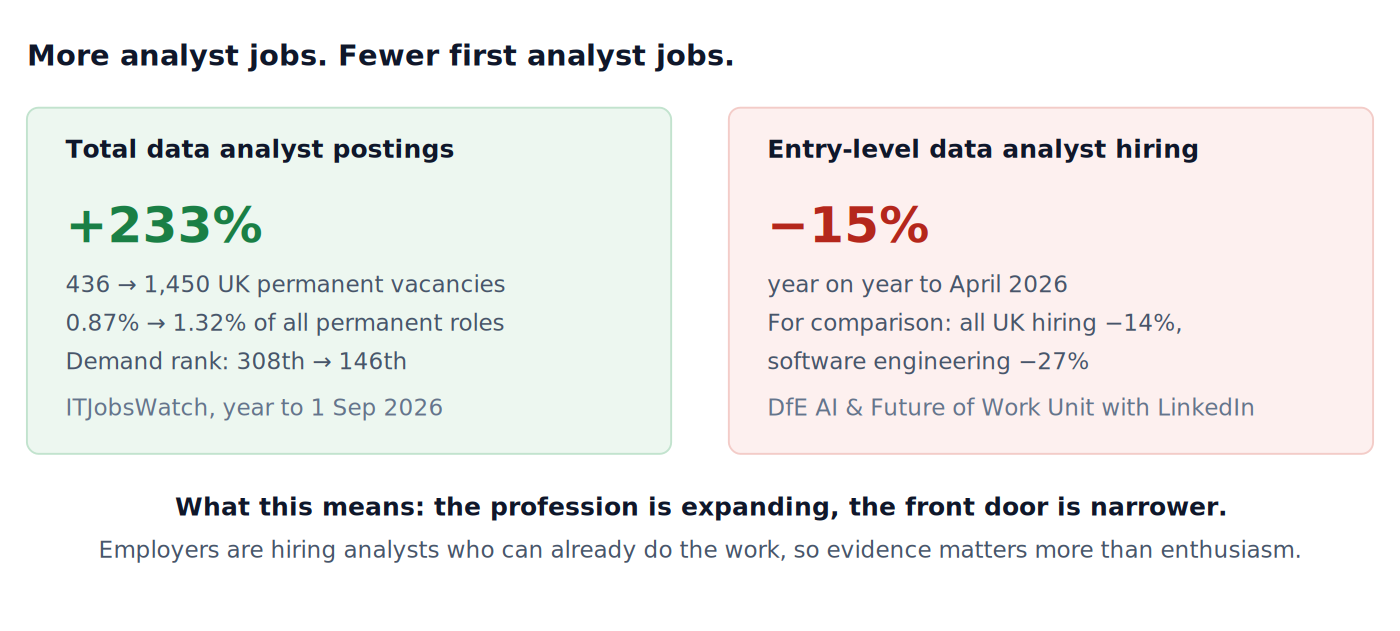
Over the six months to 1 September 2026, 1,450 UK permanent vacancies carried Data Analyst in the job title. A year earlier the figure was 436. As a share of all permanent roles advertised in the UK, data analyst postings went from 0.87% to 1.32%, and the role climbed from 308th to 146th in ITJobsWatch's demand ranking.
At the same time, entry-level data analyst hiring fell 15% in the year to April 2026, according to analysis by the Department for Education's AI & Future of Work Unit with LinkedIn.
Both are true. More analyst jobs, fewer first analyst jobs. Employers are expanding their analytics teams while becoming more cautious about people who need a long ramp-up. Which means the job search is less about finding vacancies and more about being obviously ready for the ones you find.
Search these titles, not just one
The single most common mistake is searching one phrase. UK employers use at least a dozen titles for what is functionally the same job.
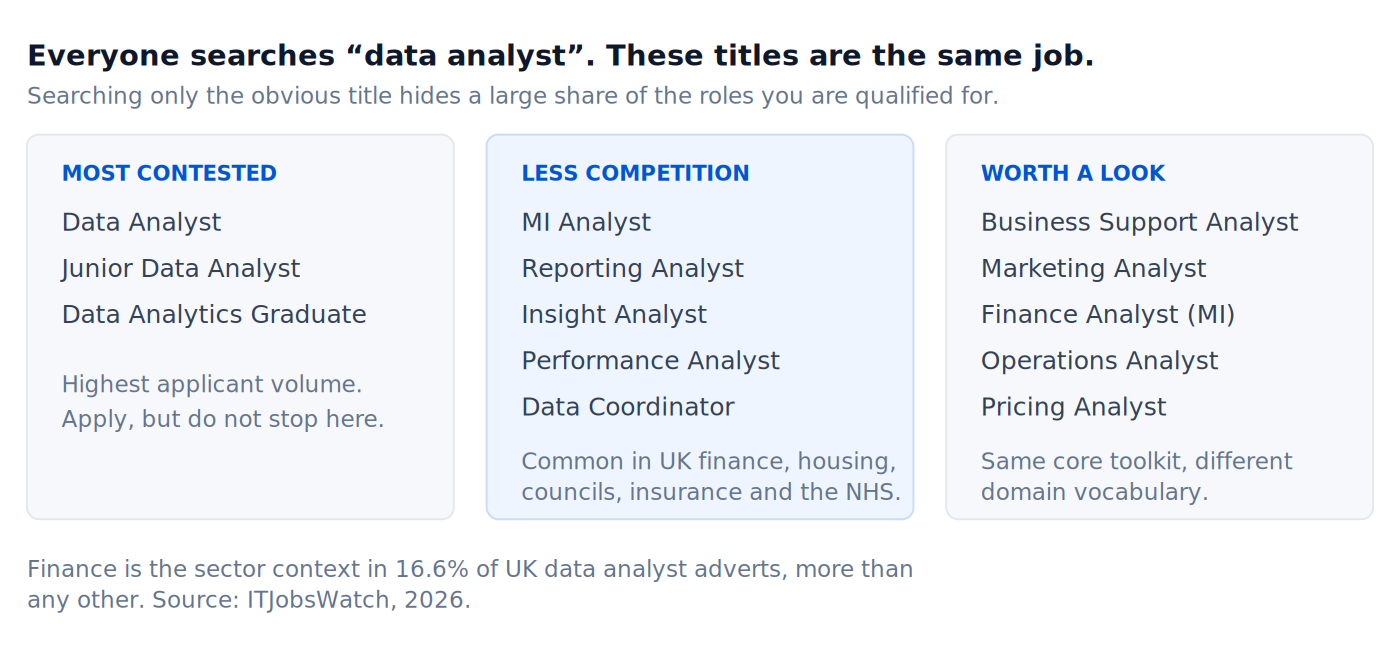
MI Analyst deserves special mention. Management information analyst roles are everywhere in UK finance, insurance, housing and local government, they use the same SQL and Power BI skills, and almost no career changer searches for them. The applicant pools are noticeably smaller.
Set up saved alerts for at least six titles across Reed, Indeed, LinkedIn, Totaljobs and CV-Library, plus NHS Jobs and the Civil Service Jobs site if you are open to the public sector. Both of those advertise roles that never appear on the commercial boards.
Where the roles actually are
England accounted for 1,302 matching adverts, of which 1,201 were outside London. The regional picture matters more than most job seekers assume.
| Region | Matching adverts | Advertised median | Demand rank change |
|---|---|---|---|
| North of England | 415 | £45,000 | +147 |
| South East | 221 | £45,000 | +110 |
| Midlands | 220 | £45,000 | +76 |
| London | 226 | £57,500 | −8 |
| Work from home | 212 | £50,000 | +39 |
| Yorkshire | 177 | £45,000 | +72 |
| South West | 135 | £50,000 | +35 |
| East of England | 92 | £55,000 | +53 |
| Scotland | 70 | £65,000 | +47 |
Two things stand out. London is the only major location where demand ranking fell and where the advertised median declined year on year, by 9.8%. And 212 roles were advertised as home-based, at a £50,000 median, which is the same as the national figure.
If you have been searching London only, you are competing hardest for the smallest slice of the market. Our full breakdown of London versus the rest of the UK has the detail.
Who is hiring
Finance is the most common sector context, appearing in 16.6% of data analyst adverts. Retail appears in 4.3%, marketing in 4.3%, public sector in 1.3% and the NHS explicitly in 0.6%, though public sector roles are systematically under-represented on commercial job boards because many are advertised only on government sites.
For someone entering the field, the useful distinction is not sector prestige but hiring behaviour:
- Large employers with graduate schemes filter hard, often on degree class, and run long structured processes. Worth applying to, not worth relying on.
- Mid-sized businesses and the public sector assess capability more directly and are where most career changers actually get their first role.
- Agencies and consultancies hire in volume, offer fast exposure to many datasets, and pay slightly below market at junior level.
What the adverts are screening for
Across UK data analyst vacancies, SQL appears in 56.0%, Power BI in 49.2%, Python in 45.8%, Excel in 44.5% and communication skills in 43.9%. AI now appears in 39.6%. A degree of any kind appears in 2.9%.
That last figure is the one that reframes the whole search. Employers are not screening on credentials. They are screening on whether you can demonstrate the work. See our full skills breakdown for the ranked list.
A search routine that works
Set the alerts once, properly. Six titles, three or four boards, plus NHS Jobs and Civil Service Jobs. Then stop browsing daily; browsing feels productive and is not.
Apply narrowly. With graduate-open postings around 7% down year on year and many roles drawing three-figure applicant counts, fifteen tailored applications beat two hundred generic ones. Every time.
Mirror the advert's vocabulary. If it says Power BI and SQL, those words need to be on your CV in the same form, describing something you actually did.
Lead with an outcome. "Built a Power BI report that identified £40k of duplicated supplier spend" is a different application from "Proficient in Power BI".
Apply within 48 hours. Many UK employers review on a rolling basis and close early when they have enough candidates.
Track everything. A simple sheet with company, role, date, source and outcome. After thirty applications the pattern in your rejections tells you what to fix.
If you are not getting responses
Diagnose where it is failing rather than applying harder.
- No responses at all usually means a CV problem: missing keywords, or no linkable evidence.
- Screening calls but no technical stage usually means your experience story is not landing.
- Technical stage but no offer usually means SQL depth or the ability to explain your reasoning.
Each has a different fix, and applying to more roles fixes none of them.
Frequently asked questions
How many data analyst jobs are there in the UK? Over the six months to 1 September 2026, 1,450 UK permanent vacancies carried Data Analyst in the job title, which is 1.32% of all permanent roles advertised. That is up from 436 postings, or 0.87%, a year earlier.
Which UK sector hires the most data analysts? Finance appears as the sector context in 16.6% of UK data analyst adverts, more than any other. Retail and the public sector follow, and the NHS, housing associations and local government hire more genuinely junior analysts than technology companies do.
Where are the most data analyst jobs in the UK? England accounted for 1,302 of the matching adverts, with 1,201 outside London. The largest regional concentrations were the North of England, the South East and the Midlands. London itself had 226.
Are data analyst jobs hard to get in 2026? Harder at entry level than three years ago, and no harder than average once you have a year of experience. The 15% fall in entry-level hiring tracks a wider labour market slowdown rather than anything specific to data.
Sources: ITJobsWatch, Data Analyst job trends, locations and skills co-occurrence data, 6 months to 1 September 2026; Department for Education AI & Future of Work Unit with LinkedIn, A snapshot of entry-level hiring in the UK, April 2026; Indeed data reported by the Financial Times, August 2026.
Read next
- Data analyst salary UK 2026: advertised vs actual pay
- Junior data analyst jobs: how to get shortlisted
- What a UK data analyst job description really says
Get job-ready, not just course-ready
Uptrail's Data Career Programme is a six-month, part-time, mentor-led pathway from spreadsheets and SQL through to Power BI, machine learning and applied AI, ending in portfolio projects built on real UK sector data.
Explore the Data Career ProgrammeBook a free consultation