
How AI Is Changing the Data Analyst Role in 2026

AI appears in 39.6% of UK analyst adverts while entry-level hiring fell 15%. Everything else follows from those two numbers.
Two numbers describe what AI is doing to this profession better than any prediction.
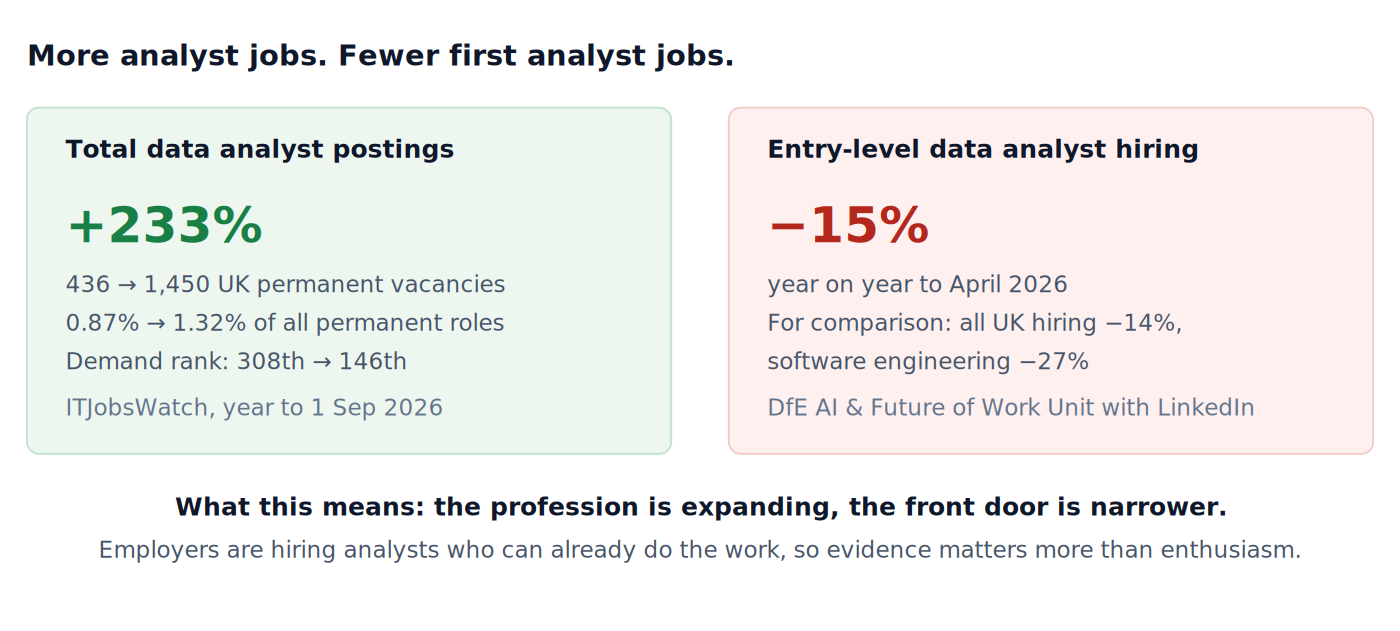
AI now appears in 39.6% of UK data analyst job adverts. Over the same period, entry-level data analyst hiring fell 15% year on year, while total data analyst postings rose from 436 to 1,450.
Employers are hiring more analysts, hiring for AI-assisted analysis, and hiring fewer people at the very bottom. Everything else follows from that.
What is genuinely being automated
Boilerplate query writing. Drafting SQL from a described requirement is something assistants do well, particularly for straightforward aggregations.
First-pass data profiling. Summarising a dataset's shape, spotting obvious anomalies, suggesting types.
Routine cleaning. Standardising categories, parsing inconsistent dates, deduplicating.
Documentation and first drafts. Commenting queries, writing report summaries, drafting the narrative around a chart.
Explaining unfamiliar code. Genuinely useful when you inherit someone else's 300-line query.
Notice what these have in common: they are the tasks that used to fill a junior analyst's first six months. That is precisely why the entry-level rung has thinned, though it is worth saying plainly that the causation is disputed. Skills England's 2026 assessment concluded it remains hard to separate AI's effect from wider economic conditions, and overall UK hiring fell 14% across the same period. AI is part of the picture; it is not the whole picture.
What AI is still bad at
Knowing which question matters. An assistant will answer the question you ask. It will not tell you that your stakeholder asked for conversion rate when what they needed was conversion rate by channel, excluding internal traffic.
Understanding your data model. This is the sharp edge. An AI writing SQL against a schema it has misunderstood will produce a syntactically perfect query that silently duplicates rows through a one-to-many join. The output looks completely normal. Only someone who understands the grain catches it.
Judging whether an answer is plausible. AI has no sense that a 340% month-on-month increase in a mature market is almost certainly a data problem.
Accountability. Someone has to put their name to the recommendation. That has not moved and is unlikely to.
The skills that have become more valuable
Validation. Comfortably the biggest shift. When producing an answer is cheap, verifying it becomes the scarce skill. Data quality already appears explicitly in 13.2% of UK adverts and functions as an implicit requirement in the rest.
Framing the question. Deciding what should be measured, and pushing back when a request would produce a misleading answer.
Communication. Listed in 43.9% of adverts, and rising in relative importance as execution gets cheaper.
Data modelling. Understanding how tables relate is what lets you catch the errors AI makes. It has quietly moved from a nice-to-have to a defence mechanism.
Domain knowledge. Knowing that NHS financial years start in April, or that retail December distorts every trend, is context AI does not reliably supply.
The skills that differentiate you less than they used to
Syntax memorisation. Recalling exact function signatures is worth less. Understanding what the function does, and when it gives the wrong answer, is worth more.
Manual report production. Building the same report by hand every month was never a career, and it is now automatable.
Speed of execution alone. Being fast at writing queries matters less when drafting is nearly free.
Note carefully: less valuable as a differentiator does not mean unnecessary. You cannot validate SQL you could not have written. The fundamentals have shifted from being the output to being the quality control.
What this means if you are trying to get in
The traditional path assumed a two-year apprenticeship of routine work during which you absorbed the craft. That period is compressing.
The practical implications:
Enter with evidence, not potential. Employers are less willing to fund a long ramp-up. A portfolio that demonstrates end-to-end capability substitutes for the ramp-up you are no longer being offered.
Learn fundamentals properly, then use AI heavily. In that order. Learning SQL with an AI writing your queries produces someone who passes exercises and fails interviews.
Make validation visible. In your portfolio, in your CV, in interviews. Say how you check your numbers. It is the thing employers are most anxious about and least often hear addressed.
Be specific about your AI workflow. "I use Copilot to draft queries, then verify row counts and reconcile totals before publishing" is a materially better answer than either avoiding the subject or claiming AI does everything.
What it means if you already work in data
The analysts pulling ahead are the ones treating AI as a tool they are accountable for, rather than either refusing it or trusting it. Practically: build a habit of verification, move your time toward framing and recommendation, and get comfortable being the person in the room who says the number cannot be right.
The honest forecast
Analysts are not being replaced. The role is being reweighted, away from execution and toward judgement, and the entry point is genuinely harder than it was three years ago.
That is not a reason to avoid the career. Data analyst postings nearly tripled year on year and advertised pay rose 10.2%. It is a reason to enter it differently: with fundamentals you actually understand, evidence you can show, and a visible habit of checking your own work.
Frequently asked questions
Will AI replace data analysts? Not on current evidence. Demand for analysts rose sharply over the last year while the nature of the work shifted. The exposed part is routine execution, not the role.
Should I learn AI tools before SQL? No. AI fluency without fundamentals means you cannot tell when the output is wrong, which is the exact opposite of what employers are hiring for.
Which AI tools do UK analysts actually use? Most commonly Copilot inside Excel, Power BI and Microsoft 365, given Azure appears in 37.3% of analyst adverts and Azure AI in 34.2%, plus general assistants for drafting SQL and documentation.
Is it still worth starting now? Yes, with realistic expectations about the entry-level market. The profession is growing; the front door is narrower and rewards evidence over enthusiasm.
Uptrail's AI Data Analyst Career Programme threads applied AI through all six modules rather than adding it as a final week, and pairs it with the fundamentals that make AI-assisted work safe. We also run AI and data upskilling for teams already in post.
Sources: ITJobsWatch, Data Analyst job trends and skills co-occurrence data, 6 months to 1 September 2026; DfE AI & Future of Work Unit with LinkedIn, A snapshot of entry-level hiring in the UK, April 2026; Skills England Annual Skills Report 2026; Randstad Workmonitor 2026.
Read next
Applied AI, threaded through
Uptrail's Data Career Programme covers applied AI and RAG alongside the fundamentals that make AI-assisted work safe, rather than adding AI as a final week.
Explore the Data Career ProgrammeBook a free consultation