
The Data Analyst Career Path: Junior to Senior and Beyond in the UK

Each rung on this ladder corresponds to a shift in what you are trusted to decide, not just what you can do.
Data analysis has a clearer ladder than most professions, and the reason is worth understanding: each rung corresponds to a specific shift in what you are trusted to decide, not just what you can do.
Here is what each stage actually involves in the UK, with current pay benchmarks.
Stage 1: Junior / Graduate Analyst (0–2 years)
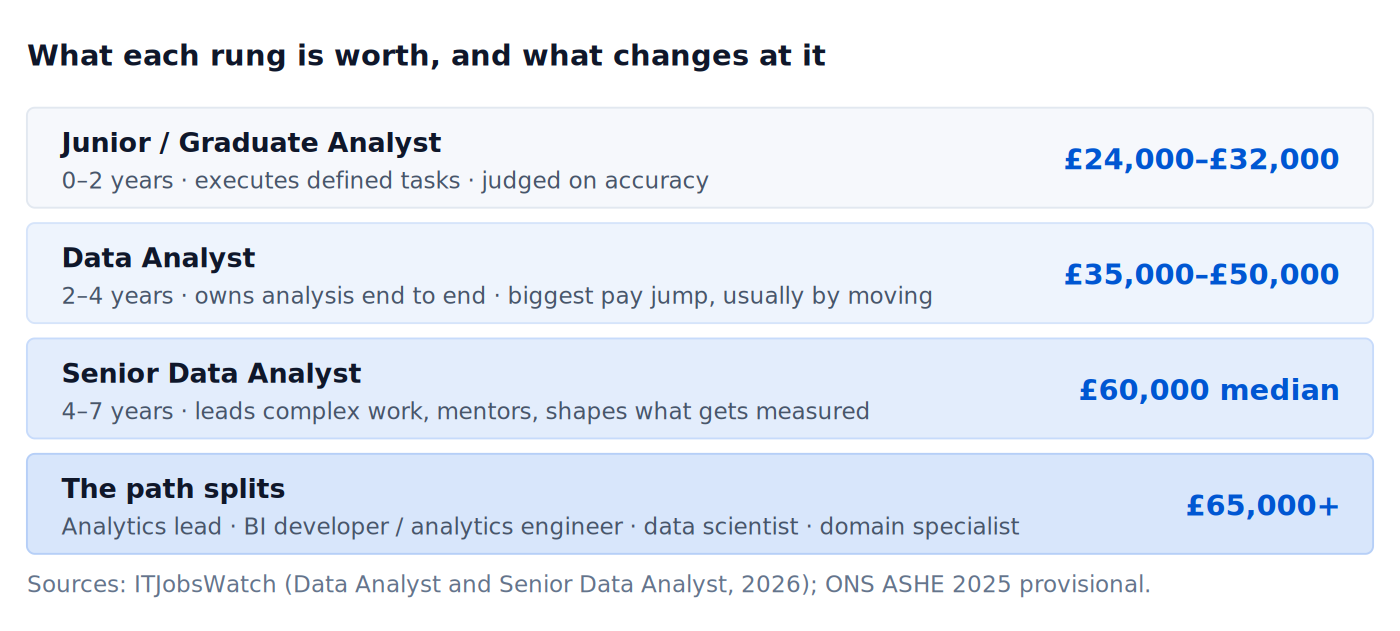
Typical advertised pay: £24,000–£32,000. The advertised 10th percentile across all data analyst roles is £32,371 and the ONS 25th percentile for people in the job is £30,000, so a first offer sitting below the national median is normal, not a red flag.
What you actually do: execute well-defined tasks. Pull this data, update that report, check why these two numbers disagree. Most of your week is cleaning, reconciling and standard reporting.
What you are being assessed on: accuracy and reliability, far more than sophistication. The junior who is never wrong twice about the same thing gets trusted with more.
What to build here: genuine SQL fluency, Power BI including modelling not just visuals, and the beginnings of judgement about when a number looks wrong. Start learning your sector's vocabulary, because domain knowledge compounds.
The trap: staying too long in a pure report-maintenance role. If after eighteen months nobody has asked your opinion about what to measure, move.
Stage 2: Data Analyst (2–4 years)
Typical advertised pay: £35,000–£50,000. The overall advertised median is £50,000 and the 25th percentile is £40,000, so this stage spans the middle of the market. This is also where the biggest single jump happens, and it usually comes from changing employer. The gap between advertised pay (£50,000) and measured pay for people in post (£38,107) is largely that effect.
What you actually do: own analysis end to end. Take an ambiguous question, decide how to answer it, do the work, present it, defend it.
What changes: you start being in the room where the question is framed rather than receiving it second-hand.
What to build here: Python if you have not already, stronger SQL including window functions, and real stakeholder skills. Communication appears in 43.9% of analyst adverts and this is the stage where it starts determining your trajectory.
Stage 3: Senior Data Analyst (4–7 years)
Typical advertised pay: £60,000 median as at 31 August 2026, with financial services and London running higher.
What you actually do: lead complex or politically sensitive analysis, mentor juniors, and increasingly influence what gets measured. You start saying no to requests that would produce misleading answers.
What changes: your value shifts from execution to judgement. Two seniors with identical technical skills differ mainly in how well they read the business.
What to build here: deep domain expertise. The senior analyst who genuinely understands pricing, or claims, or churn, is the one who becomes hard to replace.
Stage 4: Where the path splits
Analytics Manager / Head of Analytics. Leading people and setting strategy. Advertised leadership medians run substantially higher, though note that at this point you are no longer being paid as an analyst, which is why leadership figures make salary projections misleading.
BI Developer / Analytics Engineer. Deeper technically: pipelines, semantic models, dbt, warehouse architecture. Strong option if you like building more than presenting. Microsoft's DP-600 (Fabric Analytics Engineer) is the natural certification here.
Data Scientist. Heavier statistics, machine learning, more Python. Genuinely a different job rather than a promotion, and typically requires deliberate study.
Domain specialist. Becoming the definitive analyst for a function: pricing, risk, marketing effectiveness, clinical outcomes. Often the highest-paid individual contributor route.
Product / Commercial roles. Analysts move into product management and commercial strategy more often than people expect, because both value evidence-led decision-making.
What actually accelerates progression
Changing employer every two to three years, early on. The single biggest driver of pay growth, borne out by the advertised-versus-measured gap.
Choosing a sector and staying in it. Domain fluency is what makes you valuable at senior level, and it does not transfer fully between industries.
Owning something end to end. Being the person responsible for a metric, not just the person who reports it.
Communication. It is the most consistent differentiator between analysts of equal technical ability, and it is the skill people put off practising.
How AI is changing the ladder
The most significant structural change is that the junior rung is thinning. Entry-level data analyst hiring fell 15% in the year to April 2026, while overall demand for analysts rose sharply. Routine execution work, the traditional apprenticeship, is increasingly automated.
The practical consequence is that the first two years compress. New analysts are expected to reach independent-judgement work faster than a decade ago, because the work that used to fill that period is being done by tools. Which raises the bar for entry, and shortens the runway once you are in.
Frequently asked questions
How quickly can I reach senior? Four to seven years is typical. Faster in smaller organisations where you take on scope early, slower in large structured hierarchies.
Do I have to become a manager? No. Analytics engineering and domain specialism are well-paid individual contributor routes, and many organisations now have parallel technical ladders.
Is data science the natural next step? It is a common one but not automatic. Analysts outnumber data scientists in the UK market, and senior analysis pays comparably to junior data science.
Uptrail's AI Data Analyst Career Programme is designed around the compressed first two years: SQL and Power BI depth, applied AI throughout, and stakeholder communication practised rather than described.
Sources: ITJobsWatch, Data Analyst and Senior Data Analyst job trends, 2026; ONS Annual Survey of Hours and Earnings 2025 provisional, SOC 3544; DfE AI & Future of Work Unit with LinkedIn, April 2026.
Read next
Built for the compressed first two years
Uptrail's Data Career Programme covers SQL and Power BI depth, applied AI throughout, and stakeholder communication practised rather than described.
Explore the Data Career ProgrammeBook a free consultation