
Is Data Analysis a Good Career in the UK? An Honest 2026 Assessment

The case against comes first, because most articles answering this question are selling something.
Yes, for people who enjoy the work and can plan for a four to nine month runway into a job. UK data analyst vacancies rose from 436 to 1,450 in a year and only 2.9% of adverts ask for a degree. But entry-level hiring fell 15% in the year to April 2026, so getting in is harder than it was.
The case against, first
Getting in is harder than it was. Entry-level data analyst hiring in the UK fell 15% in the year to April 2026. Graduate-open postings across all fields were around 7% down year on year by August 2026, at their lowest for the time of year since 2020. Youth unemployment reached roughly 16.2% in early 2026, its highest in over a decade. This is a genuinely competitive moment to be starting out.
The junior work is repetitive. Expect to spend a large share of your first year cleaning data, reconciling sources and rebuilding reports that broke. The investigative work everyone imagines is maybe 10–15% of a junior week.
Some roles are report factories. A meaningful minority of "analyst" jobs are really report-maintenance jobs with limited influence. They pay reasonably and teach you the tools, but they can stall a career if you stay too long.
AI is compressing the bottom of the ladder. A Randstad survey in 2026 found 38% of UK employers planned to hire fewer graduates specifically because of AI. Whether AI is truly the cause or a convenient explanation for a wider slowdown is genuinely disputed. Skills England's 2026 assessment concluded it is currently difficult to separate AI's effects from economic conditions. Either way, the tasks that used to fill a junior analyst's first six months are increasingly automated.
The case for
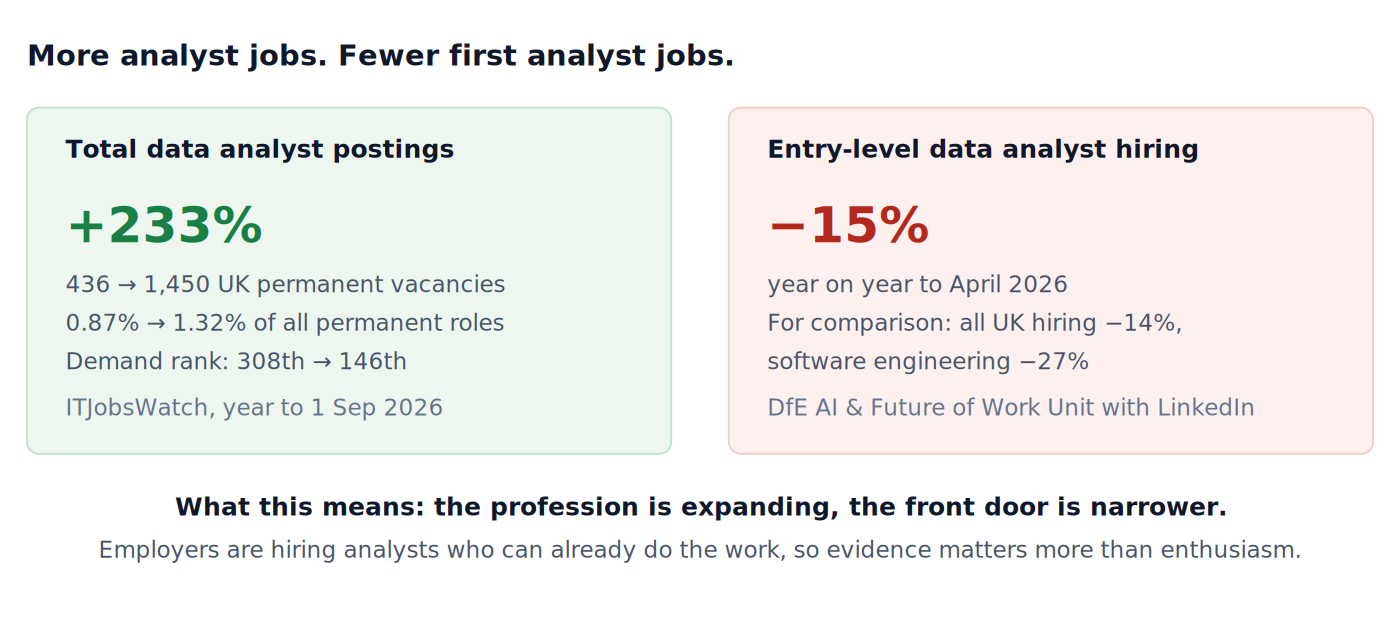
The profession itself is growing, and quickly. UK permanent vacancies titled Data Analyst rose from 436 to 1,450 year on year, moving from 0.87% to 1.32% of all permanent roles advertised, and climbing 162 places in ITJobsWatch's demand rankings. Very few occupations show that trajectory in the current market.
Pay is solid and rising outside London. The advertised median is £50,000, up 10.2% year on year. Outside London it is £45,000, up 5.9%. Measured pay for people in the job is £38,107.
The entry requirements are unusually open. A degree of any kind appears in 2.9% of UK analyst adverts. Very few professional careers at this pay level are as indifferent to what you studied.
The skills are portable across every sector. Finance, retail, NHS, local government, charities, sport, logistics. The toolkit barely changes, which makes it unusually resilient to any single industry contracting.
It is a genuine on-ramp. Data analysis leads to BI development, analytics engineering, data science, product analytics and analytics leadership. Few entry-level careers open that many doors.
Who thrives, and who does not
Thrives: people who enjoy the moment a messy pile of data resolves into something explainable. People who are stubborn about detail. People who like explaining things to non-experts. People comfortable saying "the data does not support that" to someone senior.
Struggles: people who want a purely technical role with no stakeholder contact, because communication appears in 43.9% of adverts. People who need clean, well-specified problems. People who expected modelling and machine learning, which is data science, not analysis.
You do not need to be a mathematician. You do need patience with detail and comfort with ambiguity.
The AI question, straight
The reasonable position is neither "AI will replace analysts" nor "nothing has changed".
AI now appears in 39.6% of UK analyst adverts, which means employers are hiring for AI-assisted analysis rather than hiring against it. What is genuinely being automated is the routine execution layer: boilerplate queries, first-pass cleaning, summarising a dataset's shape.
What is not automated is deciding which question is worth asking, knowing whether a number can be trusted, and carrying accountability for a recommendation. The risk is not that analysts disappear. It is that the traditional apprenticeship, where you learned the craft by doing routine work for two years, is thinning. Which puts more weight on entering with capability already demonstrated.
So, is it a good career?
For someone who genuinely enjoys the work and is prepared for a four to nine month runway from starting to learn to starting a job: yes, it remains one of the more accessible well-paid careers in the UK, with strong progression and unusually portable skills.
For someone attracted mainly by salary articles and expecting a quick transition: the current entry-level market will be punishing.
The honest test is whether the day-to-day described in what a data analyst actually does appeals to you on its own terms.
Frequently asked questions
Will data analyst jobs still exist in ten years? The role will look different, weighted further toward interpretation and judgement, but organisations are producing more data and more decisions requiring evidence, not fewer.
Is data analysis better than software engineering as a career change? Entry-level software engineering hiring fell 27% in the year to April 2026, against 15% for data analysis. Both are difficult right now; data analysis has a shorter runway to employability.
How old is too old to switch? Not a real constraint. Domain experience from a previous career is an advantage in analysis, because knowing an industry is half of being useful in it.
If you are weighing this up seriously, a free consultation with an Uptrail career adviser will give you a straight answer about fit and timeline, including if the answer is that now is not the right moment.
Sources: ITJobsWatch, Data Analyst job trends, 6 months to 1 September 2026; DfE AI & Future of Work Unit with LinkedIn, April 2026; Indeed data reported by the Financial Times, August 2026; House of Commons Library labour market briefing, 2026; Randstad Workmonitor 2026; Skills England Annual Skills Report 2026.
Read next
Find out if it fits before you commit
A free consultation with an Uptrail career adviser gives you a straight answer on fit and timeline, including when the answer is that now is not the right moment.
Book a free consultationBook a free consultation