
Business Analyst Jobs in the UK: Pay, Demand and How to Break In

Business analysis pays more than data analysis at the median and is harder to enter cold. The route in is different, and most candidates try the wrong one.
Business analysis is one of the better-paid non-technical routes into the technology sector, and one of the harder ones to enter directly. Both facts have the same cause: the job rewards experience of how organisations actually work, which is difficult to demonstrate without having worked in one.
What the market looks like in 2026
The median advertised UK business analyst salary is around £54,447, based on ITJobsWatch data. Related titles:
| Role | Advertised median | Period |
|---|---|---|
| IT Business Analyst | £72,500 | 6 months to 18 Feb 2026 |
| Senior Business Analyst | £62,500 | 6 months to 16 Jul 2026 |
| Business Analyst | £54,447 | 2026 |
| Business Systems Analyst | £45,000 | 6 months to 4 Jul 2026 |
| Graduate Business Analyst | £26,000 | 6 months to 10 Jul 2026 |
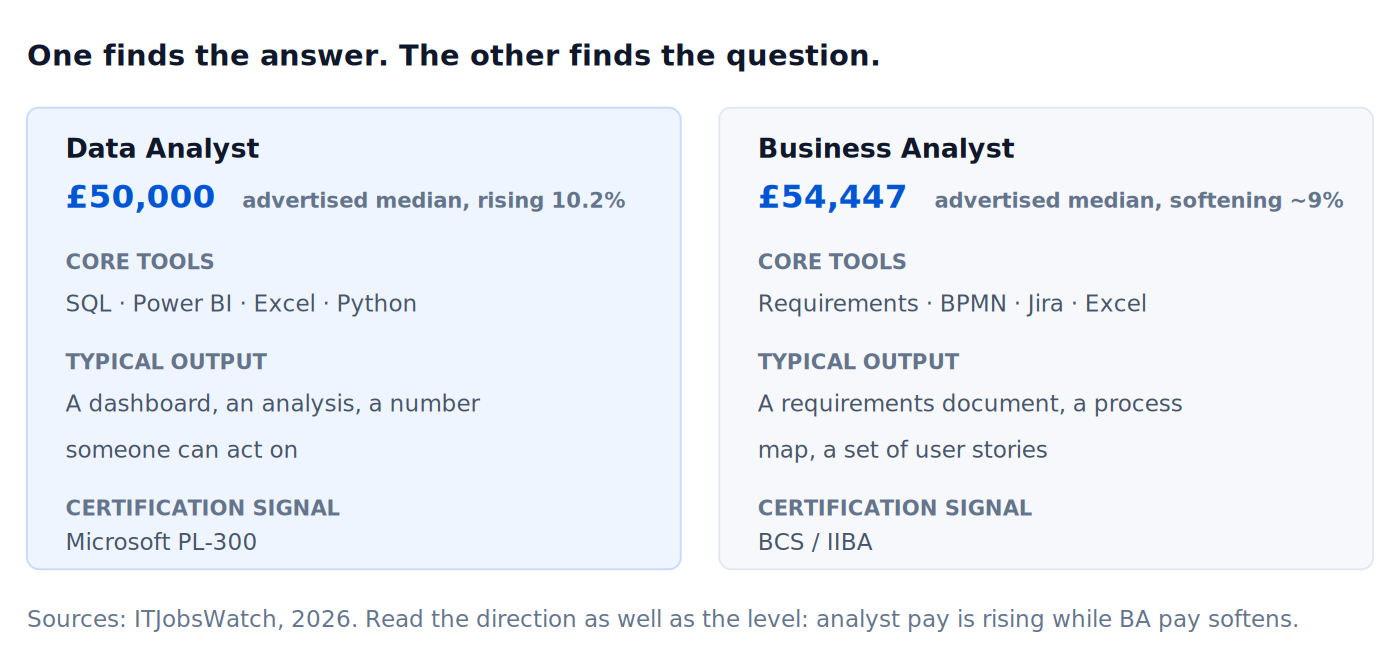
One trend matters more than the levels: BA medians are down roughly 9% year on year. Over a comparable period, data analyst medians rose 10.2%.
That reversal reflects contraction in change and transformation functions, which is where a large share of BA headcount sits, and it means the current market leans toward employers. It is still a well-paid, resilient career. It is a moment when standing out matters more than it did two years ago.
Which sectors hire
Business analysis concentrates in organisations running significant change programmes:
- Financial services, comfortably the largest employer of BAs in the UK, particularly banking, insurance and payments
- Consultancies, which hire in volume and offer fast exposure across clients and industries
- The public sector, including the NHS, central government and local authorities, where digital transformation programmes are ongoing
- Utilities, telecoms and retail, typically around systems replacement and process improvement
- Software companies, where the role often shades into product ownership
The route in that most candidates miss
Here is the structural difference between business analysis and data analysis, and it changes your strategy entirely.
Data analysis has an objective skills test. You can prove SQL and Power BI capability with a portfolio, cold, from outside an organisation.
Business analysis does not. You cannot really demonstrate stakeholder facilitation or requirements elicitation in a portfolio project. Employers therefore weight prior experience much more heavily.
The consequence: the most common route into business analysis is an internal move, not an external application. People become BAs from operations, customer service, project support, finance, testing and subject matter expert roles, inside organisations that already trust them.
If you are currently employed anywhere with a change programme, the highest-probability path is not applying externally. It is volunteering for requirements work, process mapping or UAT in your current organisation, doing it visibly, and then moving.
If you are not currently employed in such an organisation, the sequence that works is: get into the organisation in an adjacent role, then move sideways. A business support or project coordinator role at a company with an active change function is a better BA route than six months of external applications.
Our guide to becoming a BA with no experience sets out both routes in detail.
What employers screen on
Elicitation and facilitation. Can you get a room of people with conflicting priorities to agree what the problem is.
Requirements documentation. User stories, acceptance criteria, functional and non-functional requirements, written clearly enough that a developer can build from them.
Process modelling. BPMN or equivalent. The ability to map a current state, identify where it breaks, and design a future state.
Agile delivery. Scrum ceremonies, backlog refinement, working with product owners and delivery teams. Increasingly assumed rather than requested.
Domain knowledge. A BA who understands insurance underwriting or NHS patient pathways is far more valuable than a generalist, and this is where prior career experience pays.
Data literacy. Increasingly common. Business analysis appears as a named requirement in 2.6% of data analyst adverts, and the reverse crossover is growing faster. A BA who can write their own SQL validates assumptions without waiting on someone else.
Certifications that carry weight
Unlike data analysis, where a portfolio does most of the work, formal certification is a meaningful signal in business analysis.
BCS (the Chartered Institute for IT) runs the most widely recognised UK route, including the Foundation Certificate in Business Analysis and the BCS International Diploma. UK employers name these explicitly in adverts.
IIBA certifications (ECBA, CCBA, CBAP) are more internationally recognised and structured by experience level, with CBAP requiring substantial documented hours.
For someone entering the field in the UK, a BCS foundation qualification alongside demonstrable process and requirements work is the strongest combination.
Frequently asked questions
How much do business analysts earn in the UK? The median advertised UK business analyst salary is around £54,447, with senior business analysts at £62,500 and graduate business analysts at £26,000. Business systems analyst roles sit lower at £45,000.
Are business analyst jobs in demand in the UK in 2026? Demand is steady but the market has cooled. Advertised BA medians are down roughly 9% year on year, reflecting contraction in change and transformation functions, while data analyst medians rose 10.2% over a comparable period.
Do you need a degree to be a business analyst? Not usually for the role itself. Employers weight relevant experience, facilitation ability and domain knowledge heavily, and BCS or IIBA certifications are the most recognised formal signals.
Is business analysis a good career to move into from a non-technical background? It is one of the best, because it rewards understanding of how organisations work more than technical depth. Operations, finance, customer service and project support backgrounds all transfer well.
Sources: ITJobsWatch job trend pages for Business Analyst, IT Business Analyst, Senior Business Analyst, Business Systems Analyst and Graduate Business Analyst, 2026; ITJobsWatch business analyst median as reported by CareersMarter, July 2026; ITJobsWatch Data Analyst skills co-occurrence data, 6 months to 1 September 2026.
Read next
- Data analyst vs business analyst
- Business analyst job description
- How to become a BA with no experience
- Business analyst salary UK
Become a job-ready Business Analyst in 12 weeks
Uptrail's Business Analysis Bootcamp covers requirements engineering, process mapping in BPMN, Agile and Scrum, stakeholder management, user stories, and working in Jira and Confluence.
See the Business Analysis BootcampBook a free consultation