
Data Analyst vs Business Analyst: Which UK Career Should You Choose?

One finds the answer. The other finds the question. Choosing comes down to whether you would rather interrogate data or people.
These two titles get used interchangeably in casual conversation and mean quite different things in a UK job advert. Choosing between them properly comes down to whether you would rather interrogate data or interrogate people.
The distinction in one line each
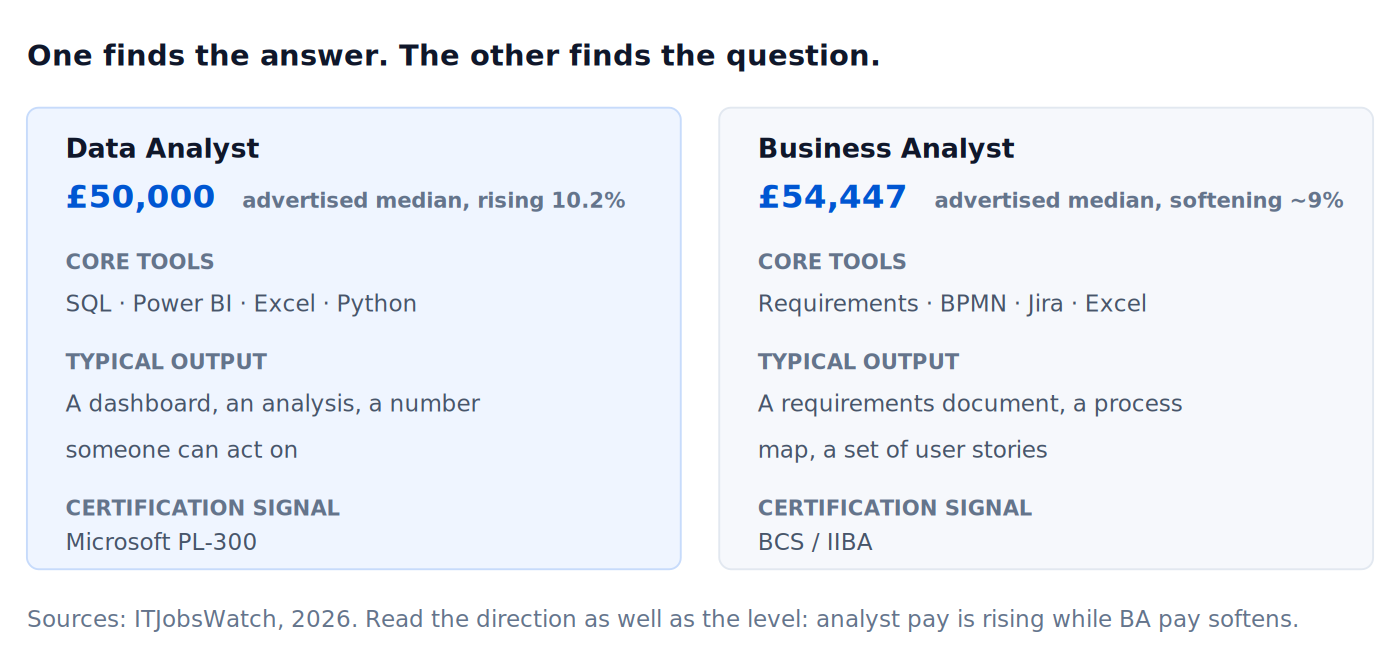
A data analyst answers questions with data. Give them a question and they will find, clean, analyse and present the evidence.
A business analyst works out which question the organisation should be asking. They sit between stakeholders and delivery teams, defining problems, mapping processes and specifying what a solution needs to do.
One produces evidence. The other produces clarity and requirements.
What each week looks like
Data analyst: SQL against source systems, cleaning and reconciling, building and maintaining Power BI reports, ad-hoc requests, presenting findings.
Business analyst: stakeholder workshops, process mapping, writing requirements and user stories, working with developers on delivery, user acceptance testing, managing change and communication.
The BA role is considerably more meeting-heavy. If that reads as a downside, that is useful information about which suits you.
Tools and skills compared
| Data analyst | Business analyst | |
|---|---|---|
| Core technical | SQL (56% of ads), Power BI (49%), Excel (45%), Python (46%) | Requirements documentation, process modelling (BPMN), Jira/Confluence, Excel |
| Core non-technical | Communication (44% of ads), data quality, analytical rigour | Stakeholder management, facilitation, negotiation, elicitation |
| Methodologies | BI, data modelling, validation | Agile, Scrum, change management |
| Typical output | Dashboard, analysis, recommendation | Requirements document, process map, user stories |
| Certification signal | Microsoft PL-300 | BCS / IIBA (CBAP, CCBA) |
The overlap is real. Business analysts increasingly need SQL and Excel; data analysts increasingly need stakeholder skills. Business analysis appears as a named requirement in 2.6% of data analyst adverts.
UK pay compared, 2026
Advertised medians:
- Data analyst: £50,000 (ITJobsWatch, to 1 September 2026), up 10.2% year on year
- Business analyst: around £54,000 on ITJobsWatch data, with the median reported down roughly 9% year on year
- Business systems analyst: £45,000 (to 4 July 2026)
- Senior data analyst: £60,000 (to 31 August 2026)
- Senior business analyst: £62,500 (to 16 July 2026)
- Graduate business analyst: £26,000 (to 10 July 2026)
Read the direction, not just the level. BA medians are currently softening while data analyst medians are rising, which is a reversal of the recent pattern and mostly reflects contraction in change and transformation functions. Both remain well-paid, and the gap at senior level is small.
Which is easier to break into?
Neither is easy in 2026, and they are hard in different ways.
Data analysis has an objective skills test. You can demonstrate SQL and Power BI capability with a portfolio, which means a career changer can prove readiness without prior employment. That is why it is the more common self-taught route.
Business analysis rewards experience you may already have. If you have run processes, managed stakeholders or delivered projects in any sector, much of that transfers directly. It is harder to demonstrate cold, but internal moves into BA roles are common, and BA is often the more realistic path if you are already inside an organisation.
How to choose
Pick data analysis if you like finding the answer yourself, prefer working with tools and evidence, and want a technical foundation that also leads to BI development or data science.
Pick business analysis if you like people, are good at drawing out what someone actually needs, enjoy structure and documentation, and are more interested in how a business works than in the data itself.
If you genuinely cannot decide, start with data analysis. The technical skills transfer into business analysis more easily than BA skills transfer into data analysis, and analysts move into BA roles routinely.
Frequently asked questions
Can I move between the two later? Yes, and many do, in both directions. Analytics-focused BA roles and business-focused analyst roles sit right on the boundary.
Which has better long-term prospects? Different, not better. Analysts progress toward data science, analytics engineering and analytics leadership. BAs progress toward product ownership, programme management and transformation leadership.
Do business analysts need SQL? Increasingly useful rather than essential. A BA who can pull their own data validates assumptions faster and is noticeably more effective.
Uptrail runs both: a 12-week live Business Analysis Bootcamp covering requirements, process mapping, stakeholder management and Agile, and a AI Data Analyst Bootcamp covering the technical stack. If you are still deciding, that is exactly what a consultation call is for.
Sources: ITJobsWatch job trend pages for Data Analyst, Senior Data Analyst, Business Systems Analyst, Senior Business Analyst and Graduate Business Analyst, 2026; ITJobsWatch business analyst median as reported by CareersMarter, July 2026.
Read next
- Business analyst jobs in the UK
- Business analyst job description
- Data analyst jobs in the UK
- Business analyst salary UK
Two paths, two programmes
Uptrail runs a 12-week Business Analysis Bootcamp covering requirements, BPMN, Agile and stakeholder management, and a six-month Data Career Programme covering the technical analytics stack.
See the Business Analysis BootcampBook a free consultation