
Data Analyst Job Description: What UK Adverts Actually Say

Job descriptions are written to be scanned, not understood. Here is what each line in a typical UK data analyst advert is actually asking for.
"Data analyst" job descriptions follow a template so consistent that once you can read one, you can read all of them. The trouble is that the template is written in HR language, and the important information is in what it emphasises rather than what it says.
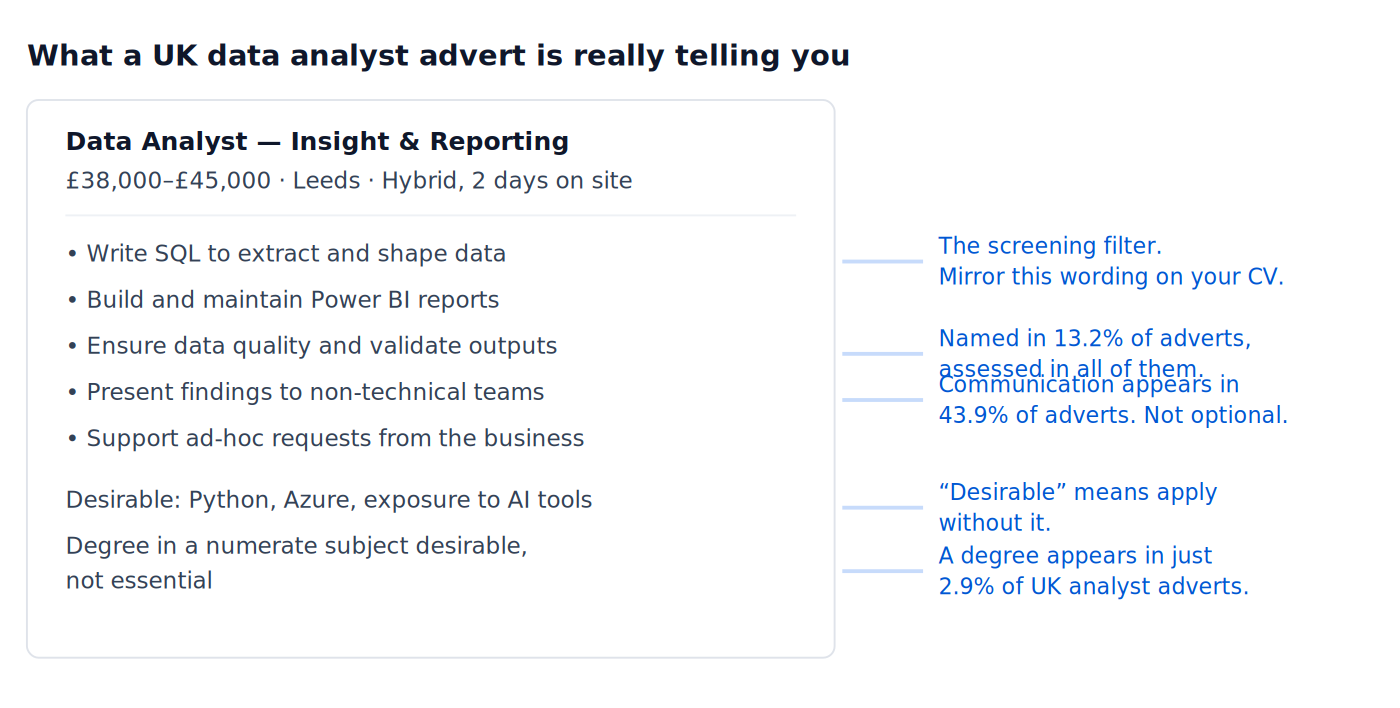
Here is a typical UK advert, annotated.
The standard structure, decoded
The salary line
Most UK adverts give a band. Treat the bottom of the band as the realistic offer for someone without directly matching experience, and the top as reserved for someone who already does the job elsewhere.
For context, the advertised median across all UK data analyst vacancies is £50,000, with a 25th percentile of £40,000. A band starting below £30,000 signals a genuinely junior role, which is useful information rather than a warning. Our salary guide covers the full distribution.
The responsibilities section
This is where the real job hides. In a typical UK advert you will see some version of:
- Extract and manipulate data using SQL. Present in most adverts, and the single most important line. SQL appears in 56.0% of UK data analyst adverts.
- Build and maintain reports and dashboards. The word maintain is doing a lot of work. Maintenance is usually more of the job than building.
- Ensure data accuracy and quality. Named explicitly in 13.2% of adverts and assessed in effectively all of them.
- Support ad-hoc requests from stakeholders. Translation: your week will be interrupted, and prioritisation is part of the role.
- Present findings to non-technical audiences. Communication and interpersonal skills appear in 43.9% of adverts, almost as often as Excel.
- Identify trends and opportunities for improvement. The genuinely analytical part, and usually the smallest share of the week at junior level.
The essential versus desirable split
This is the part candidates most often misread.
Essential is the real filter. If it lists SQL and you cannot write a join, you will not get through.
Desirable is a wish list. It exists partly to give the employer flexibility and partly because the hiring manager wrote it hopefully. Applying when you meet the essentials and roughly half the desirables is normal and correct.
The most commonly misread desirable is the degree line. A degree of any kind appears in only 2.9% of UK data analyst adverts, and a computer science degree in 0.14%. When it does appear it is almost always framed as desirable.
The tools list
Ranked by how often each appears across UK data analyst adverts: SQL 56.0%, business intelligence 50.5%, Power BI 49.2%, Python 45.8%, Excel 44.5%, AI 39.6%, Tableau 39.5%, Azure 37.3%.
Note what is missing. DAX appears in under 2% of adverts and Power Query in under 2%, despite nearly half of adverts requiring Power BI. Employers assume them rather than list them, so do not read a low mention rate as "not needed".
How to read an advert as a candidate
Count the SQL emphasis. If SQL appears once in passing, the role is probably reporting-heavy with data supplied to you. If it appears three times with detail about databases, the role is more technical and more valuable to learn in.
Look for who you report to. An analyst inside a finance or marketing team does different work from one in a central data team. The former builds domain knowledge faster; the latter builds technical depth faster.
Watch for scope creep in the responsibilities. If the list includes data engineering, dashboard building, stakeholder management and some light data science, it is a one-person data function. That can be an excellent learning role or an impossible one, depending on the support around it.
Check whether they mention data quality or governance. Employers who name it have usually been burned by a wrong report, which means they will value carefulness. That is good news for a methodical candidate.
A job description template, if you are hiring
If you are on the other side of this, here is a structure that attracts capable career changers rather than filtering them out:
Title: use the plainest one. "Data Analyst" or "Junior Data Analyst", not "Insight Ninja".
Salary: publish the band. Adverts without salaries get materially fewer applications from strong candidates.
Essentials, kept to five: SQL, one BI tool, spreadsheet fluency, clear written communication, and evidence of analytical work in any context.
Desirables, kept honest: Python, cloud exposure, sector experience, AI-assisted workflows.
Explicitly state what you do not require. A line saying you welcome applicants without a related degree, and that portfolio projects count as evidence, widens your pool considerably at no cost.
Describe a real week. Candidates who know what they are joining stay longer.
What is changing in these adverts
The fastest-moving line is AI, now in 39.6% of UK data analyst adverts, usually phrased as familiarity with AI tools or Copilot. Azure AI specifically appears in 34.2%.
What employers mean by this is rarely "can you prompt". It is closer to: can you work faster with these tools without shipping a number you cannot defend. If an advert mentions AI, expect an interview question about how you validate AI-generated output, and prepare a concrete answer.
Frequently asked questions
What are the main responsibilities of a data analyst? Extracting and cleaning data, building and maintaining reports, answering ad-hoc business questions, validating data quality, and presenting findings to non-technical colleagues. Analysis itself is a smaller share of the week than most people expect.
What qualifications do you need for a data analyst job in the UK? A degree of any kind is mentioned in just 2.9% of UK data analyst adverts. Employers screen on demonstrable tool skills instead, most commonly SQL, Power BI and Excel.
What does "desirable" mean in a job advert? It means apply without it. Essential requirements are the real filter; desirable items are a wish list, and most successful candidates do not meet all of them.
Should I apply if I meet only some of the requirements? Yes, if you meet the essentials. Meeting every desirable is unusual, and candidates who wait until they do tend to apply months later than they needed to.
Sources: ITJobsWatch, Data Analyst job trends and skills co-occurrence data, 6 months to 1 September 2026.
Read next
Learn what the job description actually asks for
Uptrail's six-week AI Data Analyst Bootcamp is built around the tools that dominate these adverts: Python, SQL, BI tools and AI, applied to real datasets and end-to-end analytics projects.
See the AI Data Analyst BootcampBook a free consultation