
Data Analyst Salary UK 2026: What the Adverts Say vs What People Are Paid

Advertised pay says £50,000. Payroll data says £38,107. Both are real, and the gap tells you how this career actually pays.
Search for this and you will get numbers ranging from £31,000 to £70,000, all presented as "the average". They are not contradicting each other. They are measuring two different populations, and once you understand which is which, the whole picture becomes readable.
The two numbers that matter
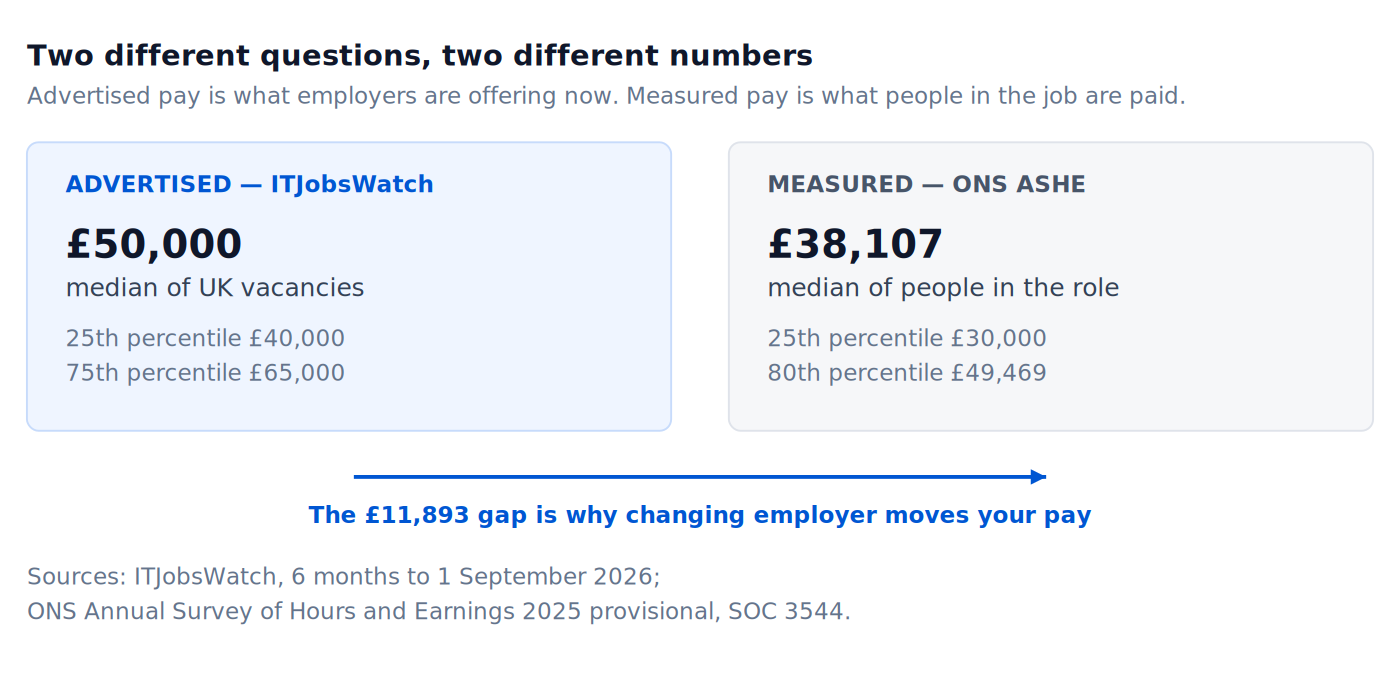
Advertised pay: £50,000 median. That is the midpoint of UK permanent data analyst vacancies over the six months to 1 September 2026, per ITJobsWatch. It reflects what employers are offering right now, and it skews upward because employers advertise ranges and post more for senior roles.
Measured pay: £38,107 median. That is from the ONS Annual Survey of Hours and Earnings (2025 provisional, SOC 3544), which samples actual payroll records of people currently doing the job. It skews lower because it includes everyone, not just those changing jobs.
A gap of nearly £12,000 between the two is normal and it tells you something useful: switching employers is where the step change happens. Your internal pay rise will track the ONS figure. Your next offer will track the advertised figure.
Third-party aggregators sit between the two. Glassdoor puts the UK average at £37,634 with a typical range of £29,574 to £48,495. PayScale reports £31,167. Reed's guide gives £35,000. All plausible, all measuring slightly different things.
The advertised distribution
| Percentile | Advertised salary |
|---|---|
| 10th | £32,371 |
| 25th | £40,000 |
| 50th (median) | £50,000 |
| 75th | £65,000 |
The measured equivalents from ONS ASHE: 25th percentile £30,000, median £38,107, 75th percentile £46,152, 80th percentile £49,469.
By experience level
Entry level / graduate. Realistically £24,000 to £30,000 outside London, and roughly £28,000 to £34,000 in London. ONS puts the 25th percentile of everyone in the role at £30,000; PayScale reports £26,038 for analysts with under a year of experience; the advertised 10th percentile is £32,371. Any figure above £35,000 for a genuine first analyst job is an outlier, not a target.
Two to four years. This is where the biggest jump happens, typically to the £35,000–£48,000 band, and usually through a move rather than a promotion.
Senior. The median advertised senior data analyst salary is £60,000 as at 31 August 2026. Specialists in financial services and contract roles run higher.
Beyond. Analytics leadership sits well above this, but by that point you are no longer being paid as an analyst, which is why leadership figures make salary guides misleading if you read them as a projection.
By region
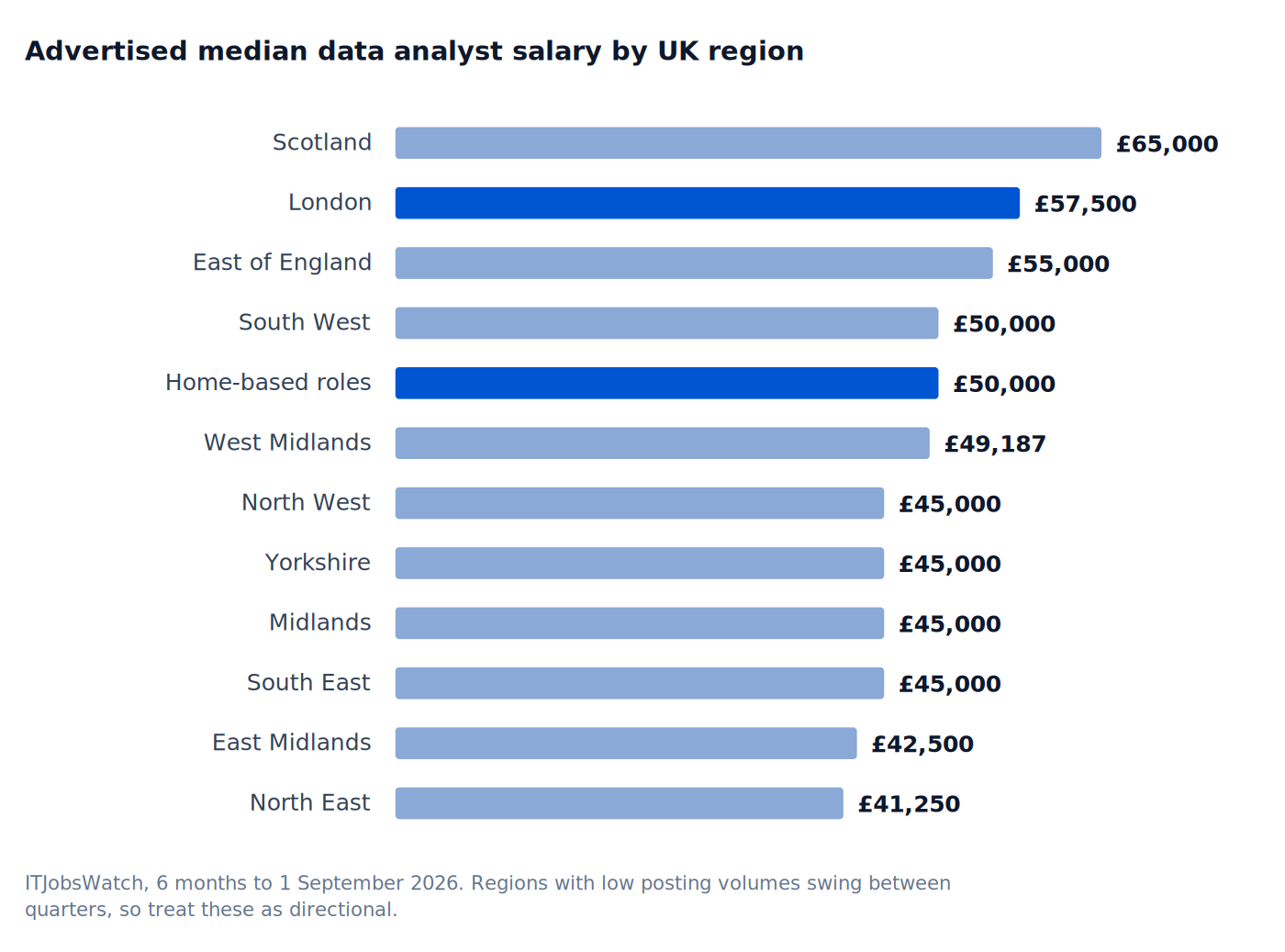
| Region | Advertised median | YoY change |
|---|---|---|
| London | £57,500 | −9.8% |
| Scotland | £65,000 | +39.8% |
| East of England | £55,000 | +15.8% |
| South West | £50,000 | +36.5% |
| West Midlands | £49,187 | +12.4% |
| North West / Yorkshire / Midlands / South East | £45,000 | +5.9% |
| East Midlands | £42,500 | +6.3% |
| North East | £41,250 | +35.3% |
| UK excluding London | £45,000 | +5.9% |
| Home-based roles | £50,000 | +2.0% |
The headline here is not the London premium, it is the direction of travel. London's advertised median fell nearly 10% year on year while every other listed region rose. Regional volumes are small enough that individual quarters swing hard, so treat the more dramatic percentages as directional rather than precise. But the pattern of narrowing is consistent, and home-based roles now advertise at the same £50,000 median as the UK overall.
What actually moves your number
Changing employer. The single largest factor, and the reason for the £12,000 gap between advertised and measured pay.
Sector. Finance appears in 16.6% of analyst adverts and generally pays above the median. Public sector, housing and charity roles typically pay below it, and offer more accessible entry.
Tool depth over tool breadth. Deep Power BI capability including data modelling, or SQL strong enough to own complex reporting, moves offers more than a longer list of tools at surface level.
Domain ownership. Becoming the person who understands pricing, or claims, or churn, is what turns a £40,000 analyst into a £55,000 one.
A note on the 2026 market
Advertised medians rising 10.2% year on year alongside a 15% fall in entry-level hiring is not a contradiction. Employers are competing for analysts who can already do the job while being more cautious about those who cannot yet. Pay is strong at the point you become hireable. Getting to that point is the hard part.
Frequently asked questions
Why do salary sites disagree so much? Because they measure different things: advertised vacancies, self-reported salaries, or payroll records. Use advertised figures to judge what to negotiate for, and ONS figures to judge what the role typically pays.
Is £30,000 a fair first data analyst salary in 2026? Outside London, yes, and it matches the 25th percentile of everyone in the role. What matters more is what you can move to after eighteen months of real experience.
Do data analysts earn more than business analysts? The medians are close and both cluster in the £45,000–£55,000 range. See data analyst vs business analyst for the fuller comparison.
Does a certification increase salary? Not directly, but PL-300 and similar credentials help you clear screening for the roles that pay more. Azure certifications appear in 34.4% of analyst adverts.
Uptrail's AI Data Analyst Career Programme concentrates on SQL, Power BI and applied AI, which are the capabilities most consistently attached to the higher end of these ranges in live UK job adverts.
Sources: ITJobsWatch, Data Analyst and Senior Data Analyst job trends, 6 months to 1 September 2026; ONS Annual Survey of Hours and Earnings 2025 provisional, Table 14, SOC 3544; Glassdoor UK, August 2026; PayScale UK 2026; Reed salary guidance 2026.
Read next
Build toward the higher end of these ranges
Uptrail's Data Career Programme concentrates on SQL, Power BI and applied AI, the capabilities most consistently attached to the upper half of UK analyst pay.
Explore the Data Career ProgrammeBook a free consultation