
What Does a Data Analyst Actually Do? A Real Week in the Role

Job descriptions are written by HR. Here is how UK analysts actually spend the week, and why the gap makes people quit in year one.
Job descriptions are written by HR. They tell you an analyst will "deliver actionable insights to drive business outcomes," which tells you nothing. Here is what the week actually looks like, and why the gap between the description and the reality causes so many people to quit in year one.
The job in one sentence
A data analyst answers business questions with evidence, and is responsible for the answer being right.
That second half is the part job adverts underplay and the part that defines the role. Anyone can produce a number. Being the person the business trusts to produce the number is the job.
Where the time actually goes
A realistic week for a junior or mid-level analyst in a UK business:
Roughly 30–40%: getting and cleaning data. Writing SQL against systems that were designed for transactions, not analysis. Reconciling two sources that disagree. Working out why last month's figure changed retrospectively.
Roughly 20%: answering ad-hoc requests. Someone in marketing needs a count. Someone in finance needs last quarter split differently. Most take twenty minutes; the skill is in spotting the one that is actually a much bigger question in disguise.
Roughly 20%: building and maintaining reports. Less glamorous than it sounds, because maintaining is most of it. Dashboards break when source systems change.
Roughly 10–15%: actual analysis. The investigation everyone imagines the job is. It is a smaller share of the week than beginners expect, and it is the part that grows as you become more senior.
Roughly 10%: communicating. Meetings, written summaries, walking a stakeholder through a chart. Communication and interpersonal skills appear in 43.9% of UK data analyst adverts, which is close to how often Excel does.
The tools, ranked by how often UK employers actually ask for them
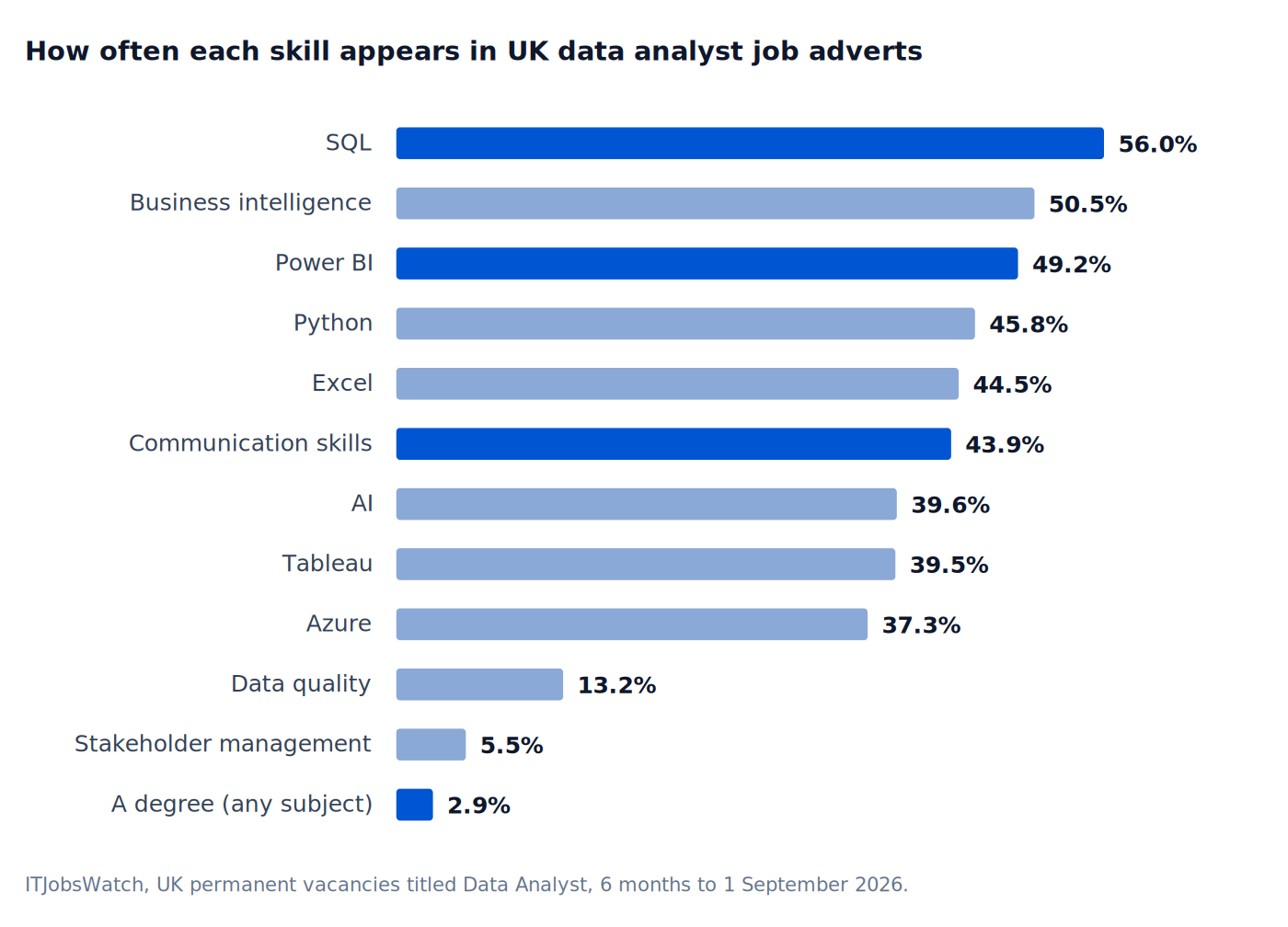
Over the six months to 1 September 2026, across UK permanent adverts titled Data Analyst: SQL appeared in 56.0%, Power BI in 49.2%, Python in 45.8%, Excel in 44.5% and Tableau in 39.5%. Azure appeared in 37.3%, reflecting how much UK analytics runs on the Microsoft stack.
Notably, DAX (Power BI's formula language) appears explicitly in under 2% of adverts, even though half of them ask for Power BI. Employers assume it rather than list it. The same is true of Power Query.
The four responsibilities that are not in the job description
Knowing which number matters. A stakeholder asks for conversion rate. The useful question is conversion by which channel, over which window, excluding which internal traffic. Reframing the request is the job.
Refusing to publish something you cannot defend. Data quality appears in 13.2% of adverts as an explicit requirement. In practice it is 100% of the job. The analyst who ships a wrong number twice loses credibility permanently.
Making the answer usable. A correct finding buried in slide 14 has no value. Actionable insight appears as a named requirement in 9.4% of adverts.
Saying what you would do next. Junior analysts report what happened. The move to mid-level happens when you start recommending what to do about it.
How the role differs by sector
The core toolkit barely changes. The context changes completely.
Finance appears in 16.6% of analyst adverts, making it the single most common sector context, and it typically means regulatory reporting, tight controls and a low tolerance for approximation. Retail means seasonality, promotions and stock. The NHS and public sector mean rigid governance and often older systems. Marketing analytics means campaign attribution and a faster, looser tempo.
Pick a sector you find interesting, because sector fluency is what makes you valuable by year three.
What AI has changed about the day
AI appears in 39.6% of UK analyst adverts now. In practice, most analysts use an assistant to draft SQL, explain unfamiliar code, summarise a dataset's shape or write the first pass of a documentation note.
What has not changed is who is accountable. If an AI-drafted query silently double-counts because of a one-to-many join, the analyst's name is still on the report. The day-to-day effect is that less time goes on typing and more goes on verification.
Frequently asked questions
Is data analysis a technical job or a business job? Both, and the ratio shifts as you progress. Junior roles are weighted toward technical execution. Senior roles are weighted toward judgement about what should be measured.
Do data analysts work alone? Rarely. Most sit inside a business function or a central analytics team and spend a meaningful share of the week talking to people who do not work with data.
How is it different from data science? Analysts explain what happened and why, mostly with SQL and BI tools. Data scientists build models to predict what will happen, with heavier statistics and Python. Analysts outnumber scientists considerably in the UK job market.
Uptrail's Data Analyst Bootcamp is deliberately built around this week rather than around a syllabus: messy data, ambiguous requests, and stakeholder presentations, because that is the part new analysts find hardest in month one on the job.
Sources: ITJobsWatch, Data Analyst job trends and skills co-occurrence data, 6 months to 1 September 2026.
Read next
Train on the week, not the syllabus
The six-week AI Data Analyst Bootcamp works with real datasets and end-to-end projects using Python, SQL, BI tools and AI, including the messy parts.
See the AI Data Analyst BootcampBook a free consultation