
How to Become a Data Analyst in the UK: The 2026 Route That Actually Works

Most guides to this were written for a job market that no longer exists. Here is the 2026 version, with the entry-level squeeze included.
To become a data analyst in the UK, learn Excel, SQL, Power BI and then Python, build three or four finished projects that answer a real business question, and apply narrowly to junior, reporting, insight and MI analyst roles. At eight to ten hours a week, most career changers need four to six months, then two to four months applying.
Here is the honest version.
The two-speed market you are actually entering
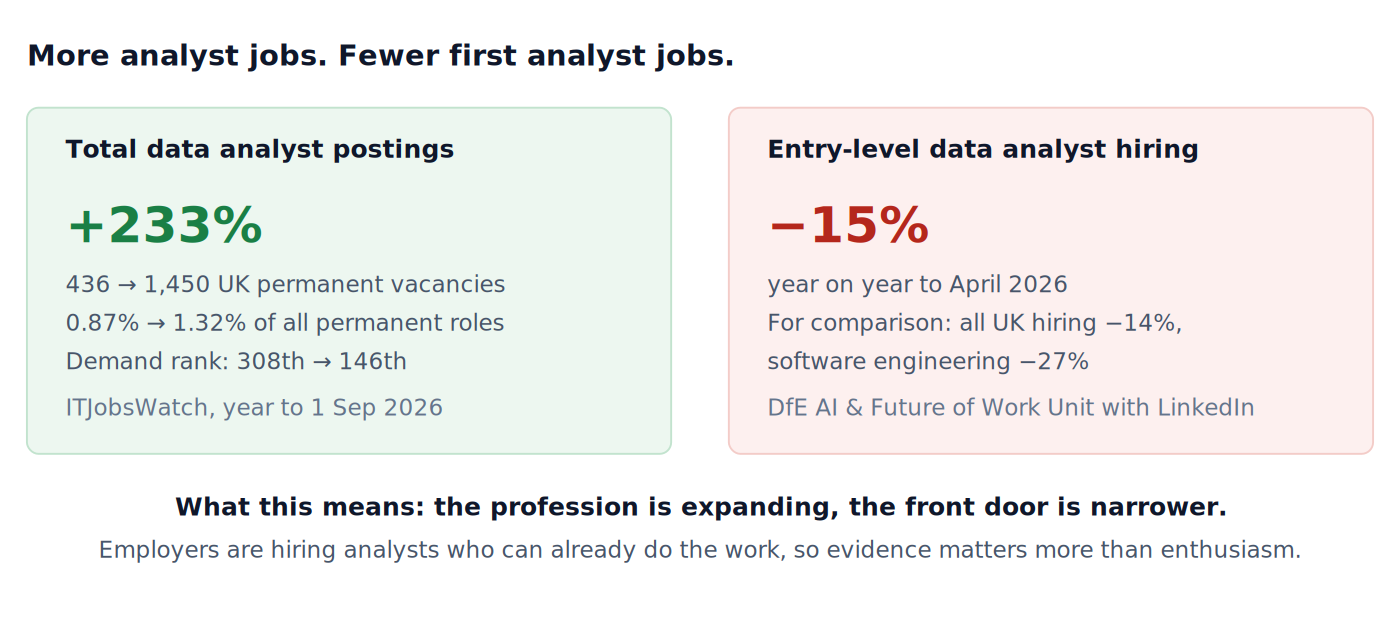
Demand for data analysts overall is genuinely rising. In the six months to 1 September 2026, 1,450 UK permanent vacancies carried "Data Analyst" in the job title, which is 1.32% of every permanent role advertised. A year earlier that figure was 436 postings, or 0.87%. The role climbed from 308th to 146th in ITJobsWatch's demand ranking. That is a real, measurable expansion.
Entry-level is a different story. Analysis published by the Department for Education's AI & Future of Work Unit with LinkedIn found that entry-level data analyst hiring in the UK fell 15% in the year to April 2026. For context, overall UK hiring fell 14% across the same period, and entry-level software engineering fell 27%, graphic design 28%, and accountancy 29%.
So: more analyst jobs, fewer first analyst jobs. The roles being created skew toward people who can already demonstrate the work.
This is not a reason to abandon the plan. It is the reason your plan has to be built around evidence of capability rather than around completing courses. Everything below follows from that.
Step 1: Learn the tools employers actually list, in the order they list them
You do not have to guess at this. ITJobsWatch tracks which skills appear alongside "Data Analyst" in UK job adverts. Over the six months to 1 September 2026:
| Skill | Appears in |
|---|---|
| SQL | 56.0% of ads |
| Business intelligence (as a concept) | 50.5% |
| Power BI | 49.2% |
| Python | 45.8% |
| Excel | 44.5% |
| AI | 39.6% |
| Tableau | 39.5% |
| Data quality | 13.2% |
Two things stand out. First, SQL is not one skill among many, it is the skill, and nothing else comes close. Second, AI now appears in nearly four in ten analyst adverts, which was not true two years ago.
The sensible learning order is Excel, then SQL, then Power BI, then Python. Not because Excel is the most valuable, but because it is where you build data intuition fastest, and every concept transfers. We break the reasoning down properly in our guide to what to learn first.
Step 2: Understand what the job is before you commit six months to it
A data analyst spends more time cleaning and questioning data than analysing it. A typical week involves pulling data with SQL, checking whether it can be trusted, building or updating a report, and explaining a finding to someone who does not work with data.
If that sounds tedious, the career will feel tedious. If it sounds like problem-solving with a purpose, you are the right fit. Our breakdown of what a data analyst actually does covers a real week in detail.
Step 3: Build proof, not a certificate collection
Only 2.9% of UK data analyst job adverts mention a degree of any kind. That statistic gets quoted a lot as good news, and it is, but people draw the wrong conclusion from it. Employers have not stopped filtering. They have moved the filter from credentials to evidence.
Which means the thing that gets you shortlisted is a small number of finished, explainable projects. Three or four is plenty. Each should answer a specific business question, use a real messy dataset, and end in a recommendation someone could act on. A dashboard with no stated question behind it is decoration.
Our guide to building a portfolio with no work experience covers structure and hosting.
Step 4: Use AI tools openly, and learn to check them
Nearly 40% of analyst adverts now reference AI. Employers are not asking whether you use Copilot or ChatGPT. They assume you do. What they are testing is whether you can tell when the output is wrong.
An AI assistant will write you a plausible SQL query against a schema it has misunderstood, and the result will look completely normal. Catching that requires understanding joins and grain well enough to notice a row count that should not be possible. This is now a genuine differentiator at junior level, and it is one of the reasons we thread applied AI through every module of our programme rather than bolting on a single lesson.
Step 5: Apply narrowly, not widely
In a market where graduate-open postings are around 7% down year on year and roles routinely attract three-figure application counts, volume applying does not work. It is the single most common failure mode we see.
Target roles titled Junior Data Analyst, Reporting Analyst, Insight Analyst, MI Analyst or Data Coordinator. Note that "MI Analyst" is a heavily used UK title that most beginners never search for. Then tailor properly: name the tools from the advert, and lead your CV with an outcome rather than a tool list.
Also widen geographically. London medians fell 9.8% year on year while the rest of the UK rose about 5.9%, and demand ranking improved far more sharply outside the capital. Yorkshire, the North West and the Midlands all sit at a £45,000 median with rising posting volumes.
How long does it realistically take?
Four to six months at eight to ten hours a week gets most career changers to a genuinely applicable standard, plus a further two to four months of applying. Anyone promising job-ready in six weeks is selling you a tool tour.
The variable that moves the timeline most is not aptitude. It is whether you are working to a structured sequence with feedback, or assembling a curriculum from free videos and stalling at the first messy dataset.
Frequently asked questions
Can I become a data analyst with no experience at all? Yes, and thousands of people in the UK do every year, but the route now runs through demonstrable projects rather than applications alone. The entry-level squeeze is real and worth planning around.
Do I need to learn Python? It appears in 45.8% of adverts, so it helps, but it is rarely the reason someone gets hired at junior level. Get SQL and Power BI genuinely solid first.
Is a bootcamp worth it in 2026? It depends entirely on whether it produces evidence you can show an employer. A course that ends in a certificate solves a problem employers stopped caring about. We cover the honest trade-offs in is a bootcamp worth it.
Uptrail's AI Data Analyst Career Programme is built around this exact sequence: Excel, SQL, Power BI and Python in order, applied AI throughout rather than as an add-on, and a guided capstone project designed to be the thing you show in interviews. It is live and mentor-led, not a video library.
Sources: ITJobsWatch, Data Analyst job trends, 6 months to 1 September 2026; Department for Education AI & Future of Work Unit with LinkedIn, A snapshot of entry-level hiring in the UK, April 2026 data; Indeed hiring data reported by the Financial Times, August 2026.
Read next
A structured route, not a video library
Uptrail's Data Career Programme is a six-month, part-time pathway from spreadsheets and SQL through to machine learning and applied AI, with live drop-in clinics and career coaching.
Explore the Data Career ProgrammeBook a free consultation